


The Realm at a Glance
- Territory
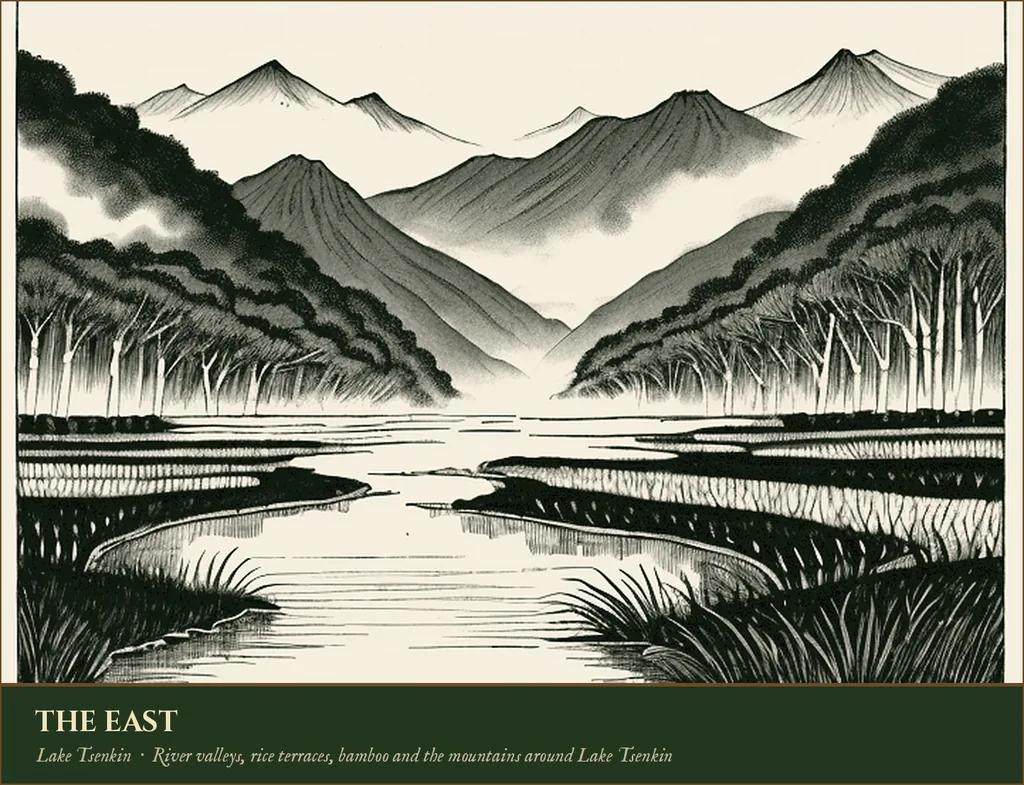
- The whole eastern third of the continent: river valleys, rice terraces, bamboo forests, coastal cities, and the mountain country around Lake Tsenkin.
- Capital
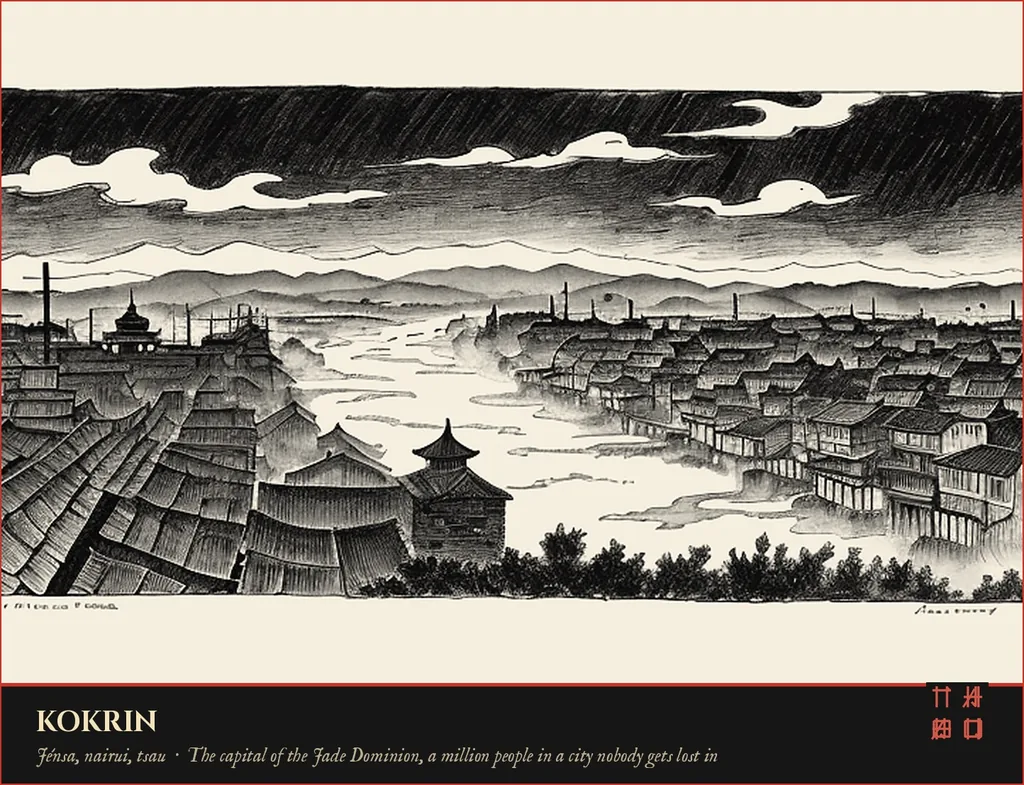
- Kokrin, the largest city in the world (over 1 million), laid out in a perfect grid, with the vermilion-walled Palace of Measured Harmony at its heart.
- Other cities
- Chaiyo (coast), Tsenkin (the archive-city on the lake), Sorogei, Shanyo.
- The Long Rampart
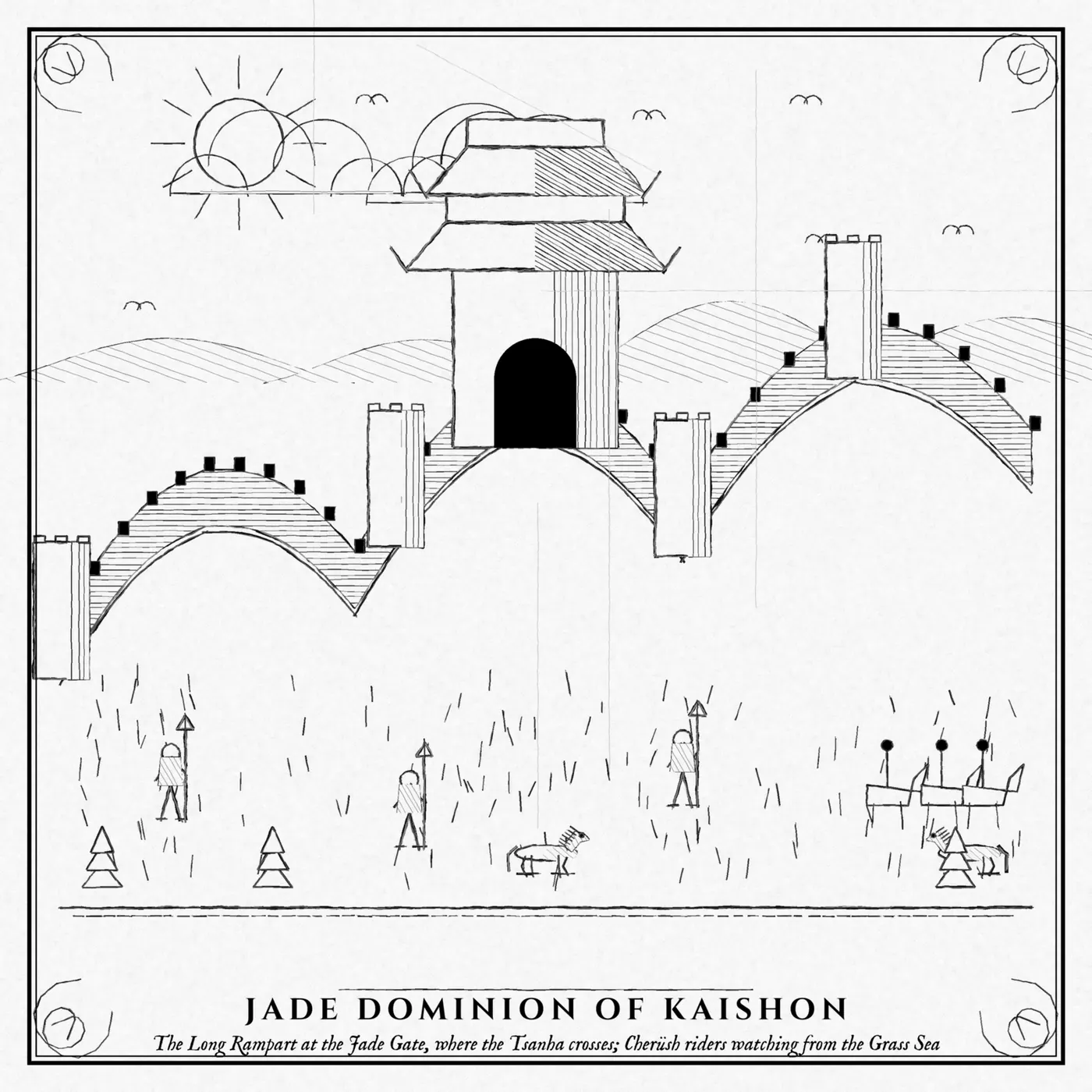
- A great wall running 1,100 miles along Kaishon's western border, facing the Grass Sea.
- Government
- The Emperor at the top, and beneath him a vast body of officials chosen by examination, not by birth. The throne's right rests on the Mandate of Merit: an emperor who rules badly can, by the teaching, be put aside.
- Ruler
- Emperor Tokrai Shaiku (71), gravely ill and seldom seen.
- Key figures
- Grand Chancellor Seiro Makok, who holds the real power; Princess Tokrai Seitotai (29), the emperor's daughter and the ablest heir, whom the old-guard ministers refuse to accept; General Dezau Honmyan, commander of the Long Rampart.
- Religion
- Officially atheist. The state follows the Doctrine of Ordered Reason, a teaching of duty, merit, harmony and learning. Gods and spirits are waved away as superstition. Peasants still leave offerings for the household spirits where the magistrates cannot see.
- Economy
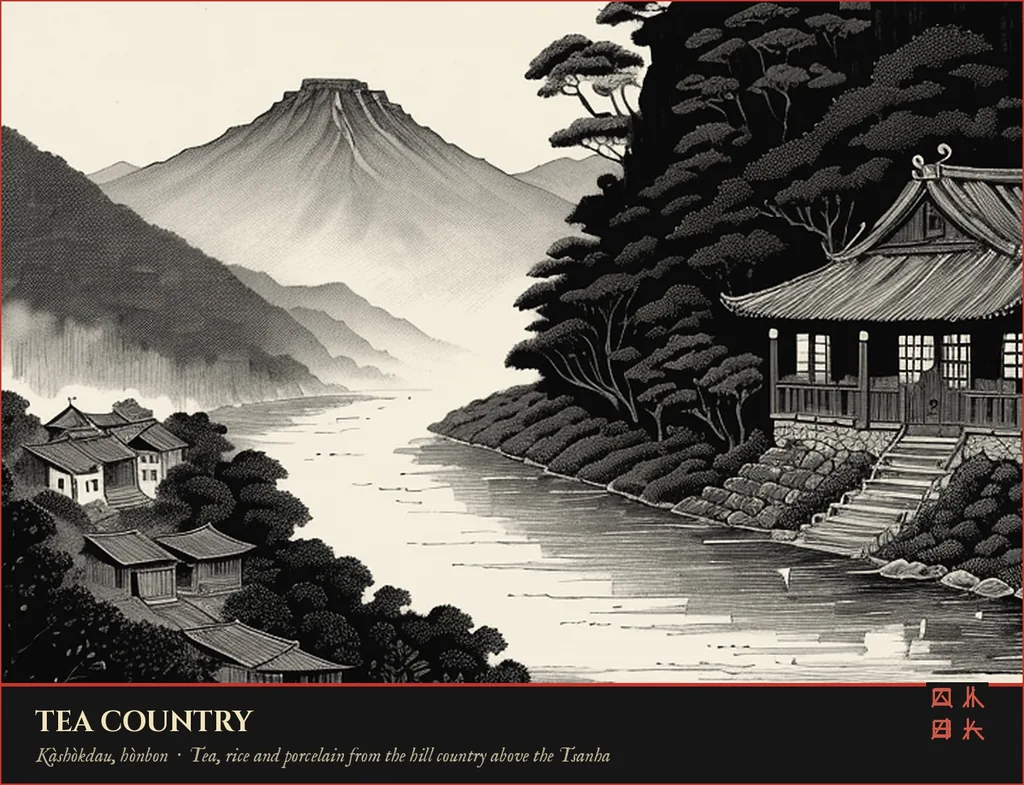
- Silk, porcelain, tea, rice, iron and steel in great quantity, paper, lacquerware, and goods made by the thousand in the state workshops.
- Military
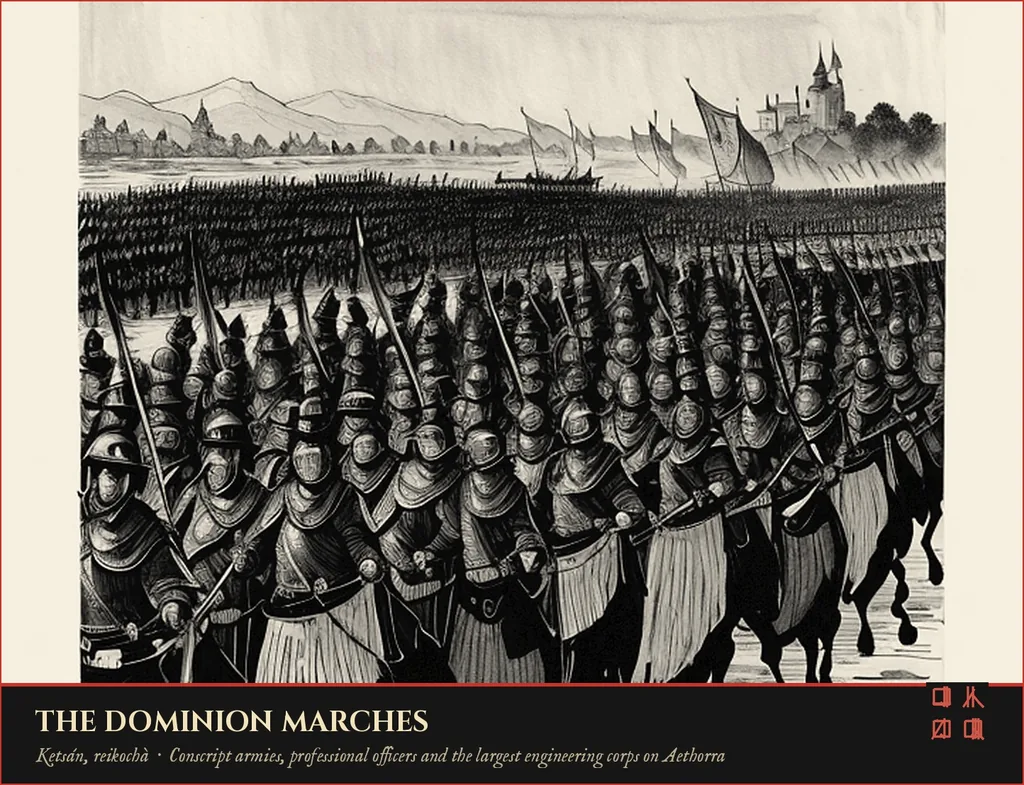
- Enormous conscript armies with officers who make war their life, war junks on the rivers and coasts, and more builders of works and walls than any other realm on Aethorra.
- Advanced technology
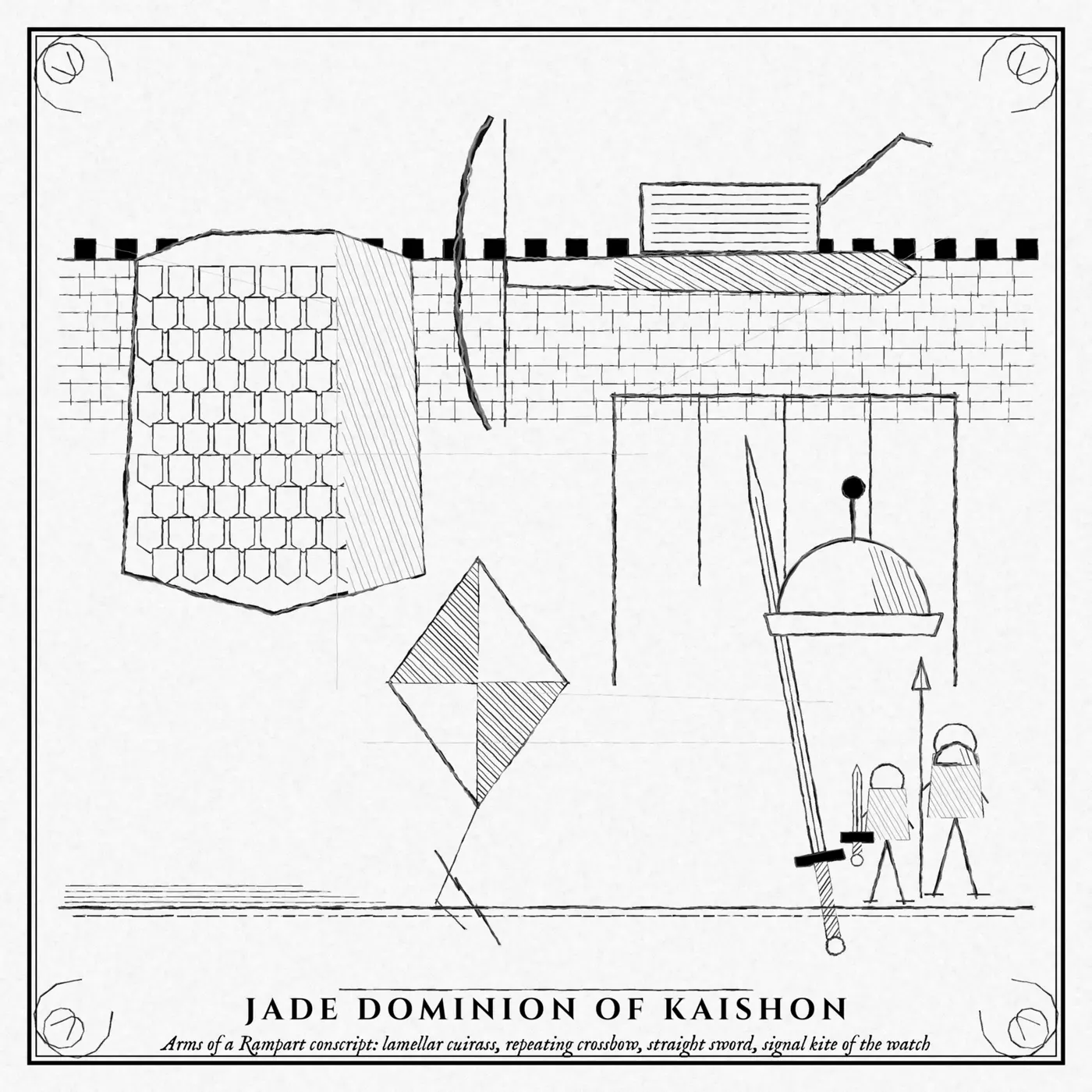
- Repeating crossbows that loose ten bolts in fifteen seconds; many-bolt siege engines; mechanical war carts; signal kites; fortifications on a scale no one else attempts.
- Architecture
- Tiered pagodas, sweeping tiled roofs, rammed-earth and brick walls, canal cities, and fortress gates the size of hills.
- Currency
- Gold mihomau, silver tsinkya. Paper notes of promise pass from hand to hand inside Kaishon and are worthless abroad.
- Strengths
- People, goods, great works, orderly government, and walls nobody has ever breached.
- Weaknesses
- Slow, rigid, and turned inward. Governors in the provinces who take bribes. A fight over the throne waiting to happen. The steppe growing more dangerous on the western border. A people who obey the state but do not love it.
Plates
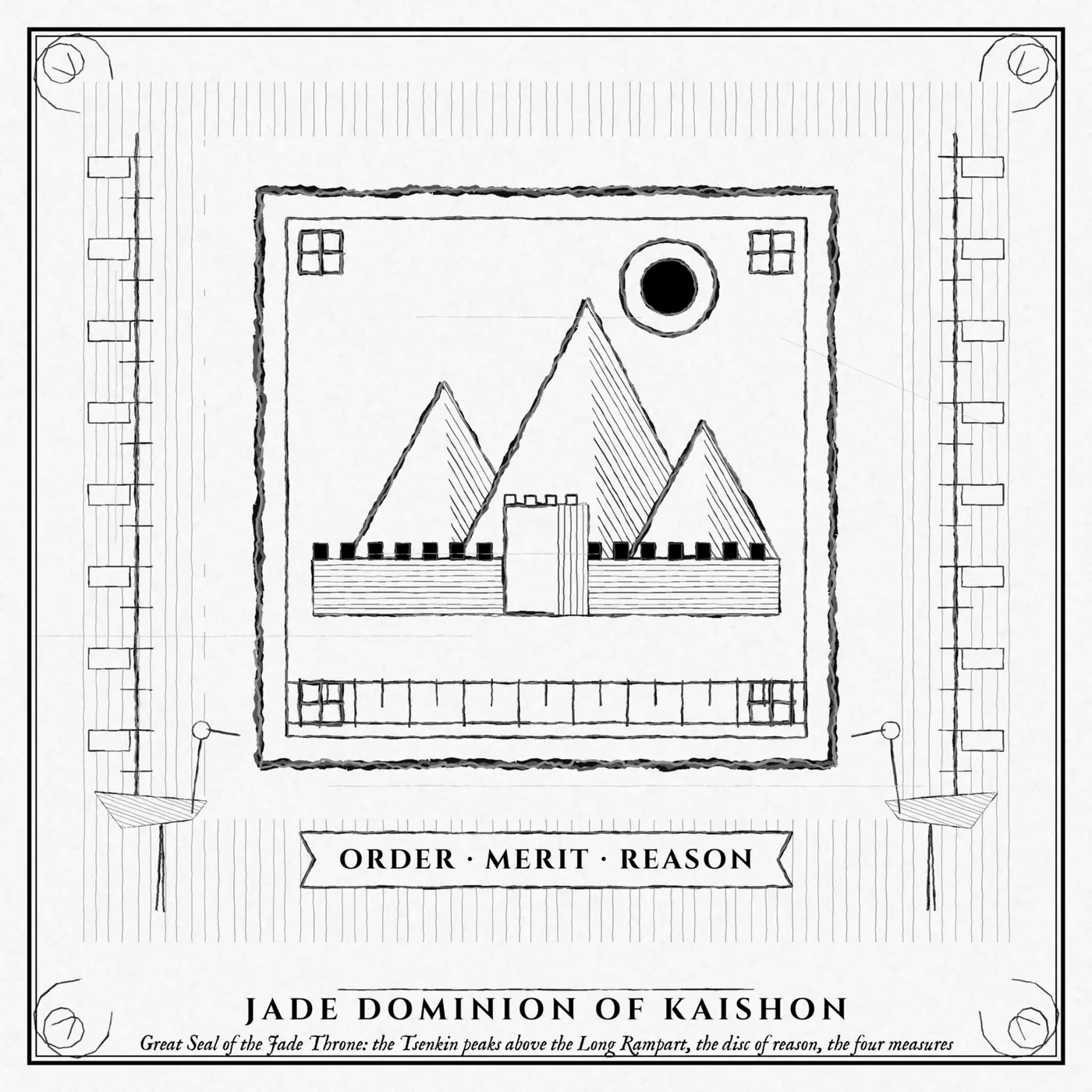
The sketchbook: crest, arms, landmark and heraldry sheets
The Land
Provinces
Imperial Heartland
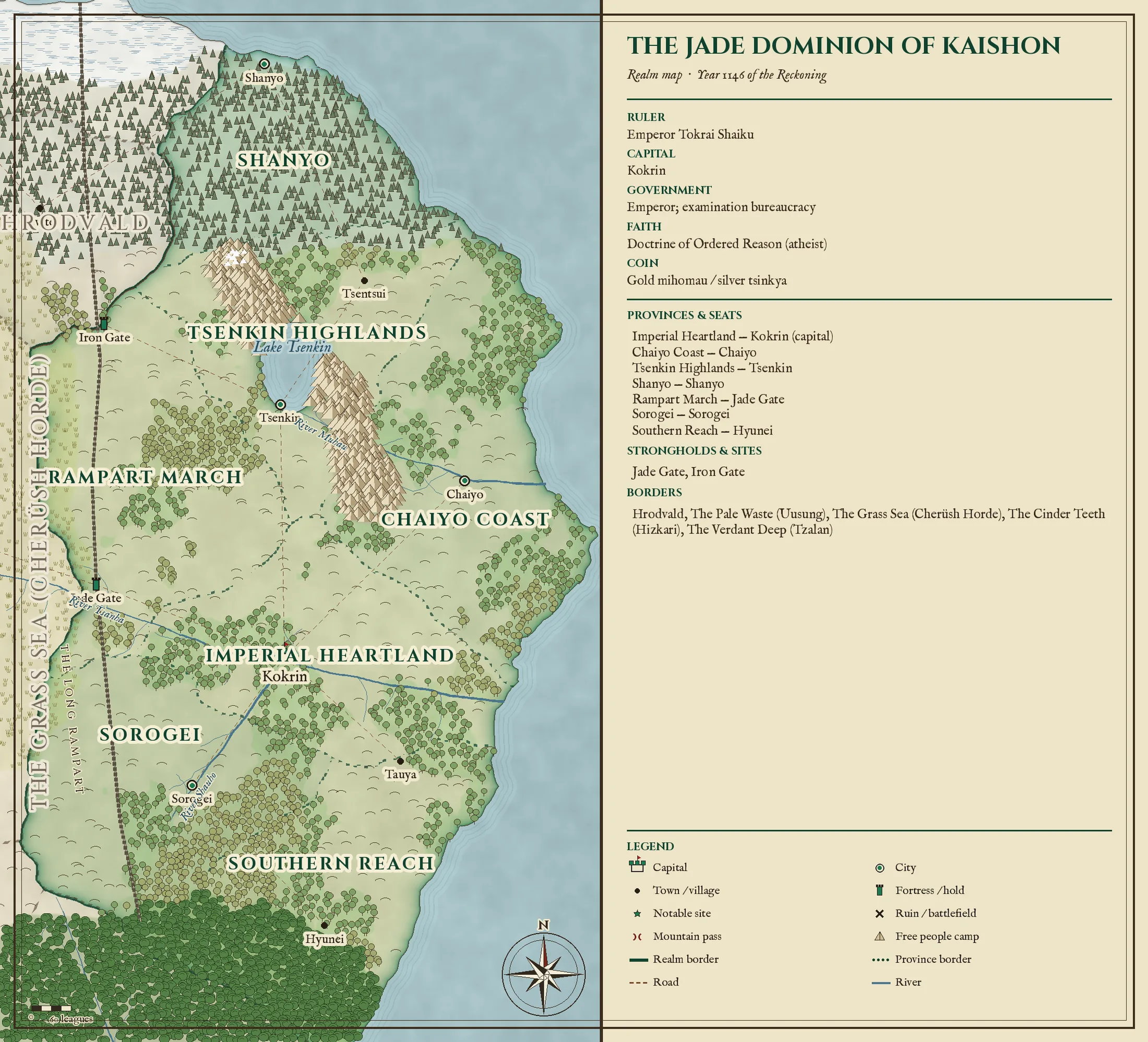
The core province of the Dominion, around the capital, Kokrin. On the map the River Tsanha and the River Shauho meet here, and the imperial roads run out from it in every direction: north to Tsenkin and Shanyo, east to Chaiyo, south to Sorogei and Hyunei, southeast to Tauya, and west to the Jade Gate.
Chaiyo Coast
The eastern seaboard province, around the port of Chaiyo and the mouth of the River Muhau. Its people live off the eastern sea: the Chaiyo tuna fleet, fishermen who fish with leashed cormorants, seaweed dried and eaten along the whole coast, and the hairy coast crab taken in the estuaries each autumn.
Tsenkin Highlands
The mountain province around Lake Tsenkin and the archive-city of Tsenkin. Its bamboo mountains are home to the Tsenkin panda, the imperial beast that is never hunted, and to the macaques that raid the archive-city's gardens.
Shanyo (province)
The Dominion's northernmost province, around the city of Shanyo, where Kaishon borders the Hrodvald lands of Clan Fevur. Its northern woods hold the spotted Shanyo deer, whose antler velvet is sold as medicine, and its hills grow Shanyo tea, the Dominion's daily drink and its second export after silk.
Rampart March
The frontier province strung along the inside of the Long Rampart, holding the Jade Gate and the Iron Gate. It is garrison country under General Dezau Honmyan, commander of the wall, whose two hundred thousand men live on paddy eels and Rampart soy.
Sorogei (province)
The southwestern province around the city of Sorogei, where the Long Rampart runs south toward the Verdant Deep. Its southern forests are the home of the singing Sorogei gibbon and the great aromatic camphor tree, whose wood makes insect-proof chests; the red Sorogei centipede is dangerous, and the Kaishon tiger, the Emperor's hunt, prowls the southern hills.
Southern Reach
The Dominion's southern frontier on the edge of the Verdant Deep, far from Kokrin and governed accordingly. In 1019 its peasants rose under the temple-keeper Tsehei Yotoke to restore the old gods, and were crushed by the Sorogei garrison; every roadside shrine in the Reach now holds a small clay head in his memory.
Voices of Kaishonsènhyo
Emperor Tokrai Shaiku
Thin, yellowed, dying slowly of something the physicians will not name. Once a vigorous reformer who rebuilt the canals and reopened the examinations to the southern provinces. Now rarely seen, propped on cushions, drifting in and out.
Grand Chancellor Seiro Makok
Immaculate gray silk, a thin gray beard, a voice like a closing door. Ninth Seiro to hold the seals of state; the family has run Kaishon's bureaucracy for six centuries and Makok has never questioned that it should. Passed the examinations first in his year at seventeen.
Princess Tokrai Seitotai
Slight, straight-backed, with her father's long face and a stillness she learned in a court that wanted her invisible. Passed the imperial examinations under a false name at twenty-two, placing third in the Dominion; when the fraud was discovered the ministers burned the paper and Makok has never forgiven her for making him do it. Reads four languages, plays buitso with generals, and has quietly cultivated the Rampart's commander for six years.
General Dezau Honmyan
Weathered, square, with a bristling gray mustache and a crossbow bolt's puckered scar in his left shoulder from a steppe raid. Has spent twenty-six years on the wall and knows every gate, every garrison, and every tribe on the far side by name. Respects Sarsak Tolmar, which he reports and the ministers ignore.
Magistrate Tsehei Kaukai
Plump, sweating, silk-robed, with soft hands and a fine collection of jade. Passed the examinations respectably and has spent fifteen years converting the Southern Reach's mahogany and pepper into personal wealth. Takes a tenth of everything, which in Kaishon is considered moderate.
Old Tsau
A bent old woman with a wide gap-toothed smile and hands like roots, who has kept an illegal shrine to the household gods on the Sorogei road for fifty years. Every magistrate in that time has known and every magistrate has decided not to notice, because their wives leave offerings there. Claims to remember the Reasoned Rebellion; is lying, and does it beautifully.
Cities and Townsgeiran
Kokrin
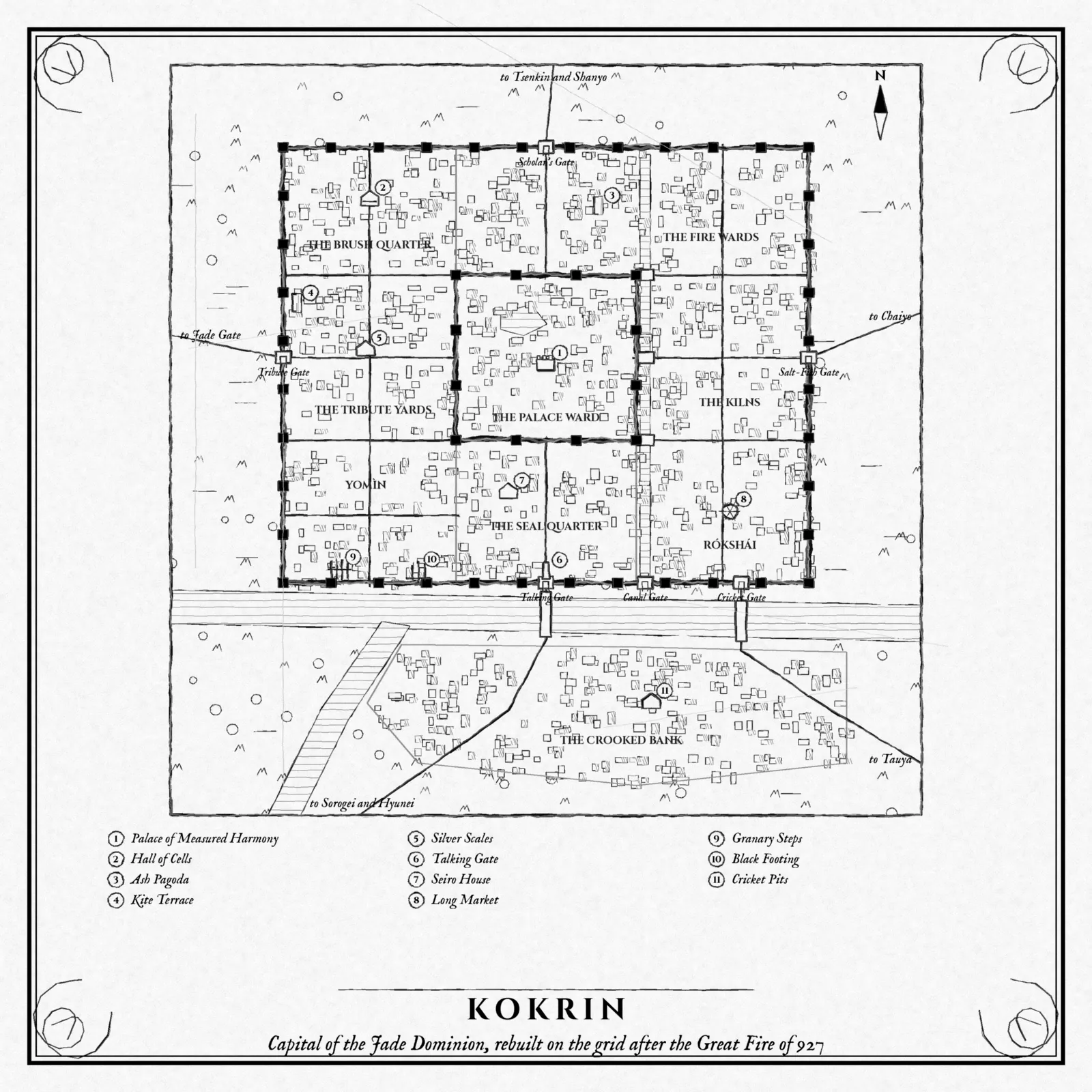
You see the kites first. Travelers on the road from the Jade Gate, ten days behind them at a cart's pace, mark them over the paddies long before the walls: red and black shapes tethered to the Kite Terrace, passing word down the line from the Rampart. Then the wall rises out of the flat rice country, rammed earth faced with gray brick, straight as a ruled line for six miles. At the Tribute Gate the air smells of river mud from the Tsanha, smoke from the state kilns on the far side of the city, and the steam of a million pots of rice.
Tsenkin
The road from Kokrin runs north twelve days and climbs the last four into the Tsenkin Range, through bamboo so thick the light turns green, and comes out above a long, cold lake with mountains down its eastern side. Tsenkin sits at the lake's southern end on stepped stone terraces, gray roofs over gray walls, with the Muhau leaving the lake just east of it in a white rush. The loudest sound in the archive-city is the macaques screaming at the ginseng walls. The second loudest is the scratch of brushes in the Page Hall.
Other towns and strongholds: Chaiyo, Sorogei, Shanyo, Hyunei, Tauya, Tsentsui, Jade Gate, Iron Gate. Every town on the continent →
Great Houses and Armsjauhû
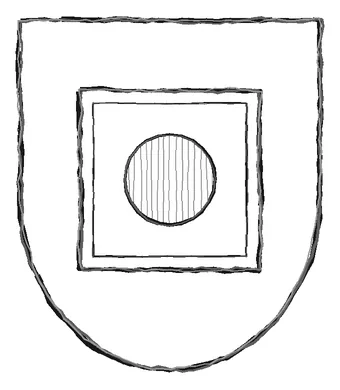
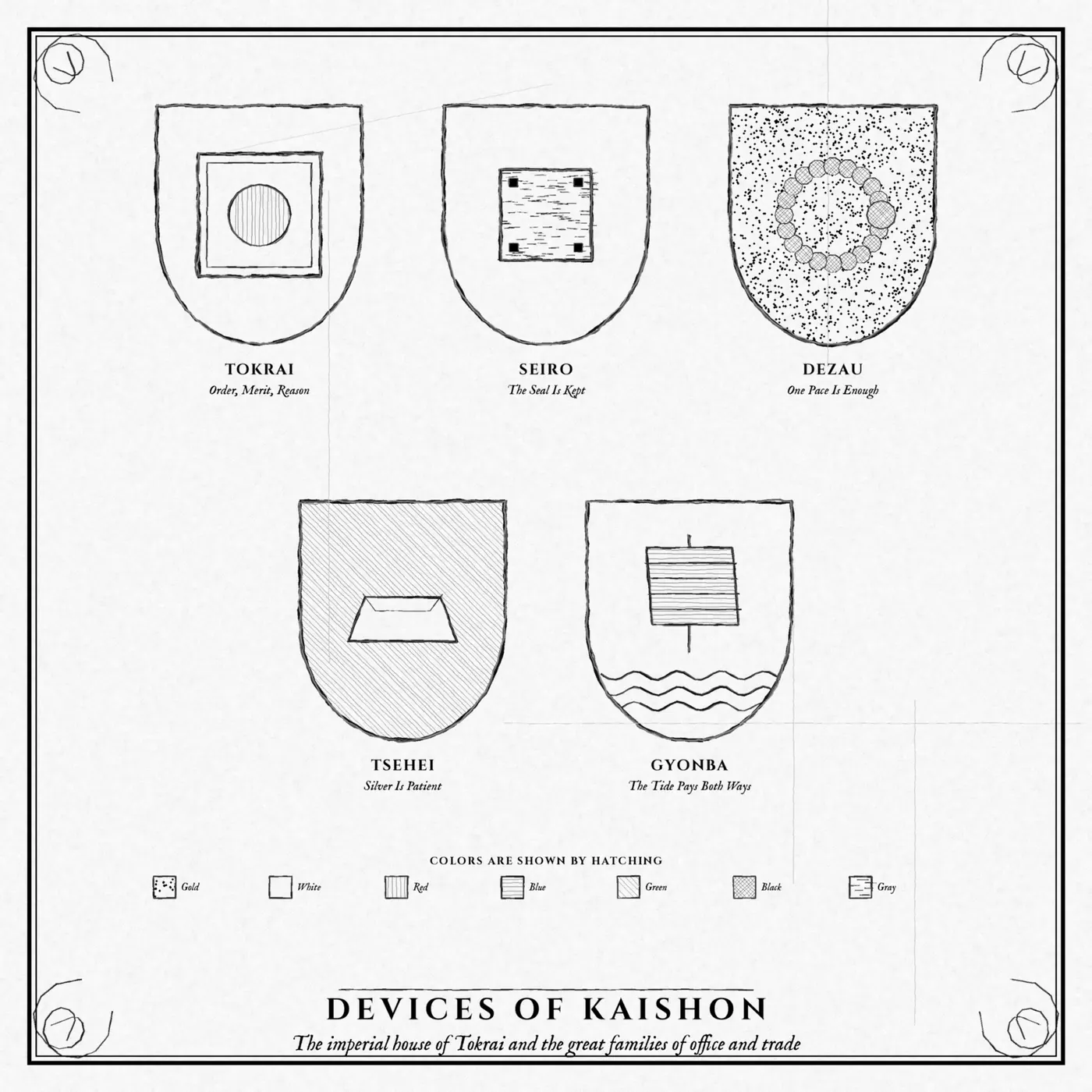
Tokrai
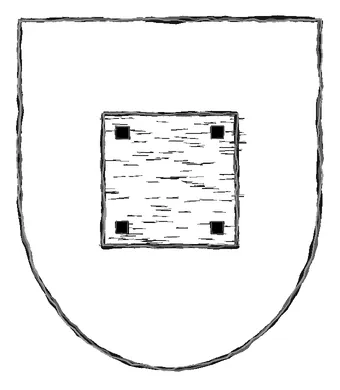
Seiro
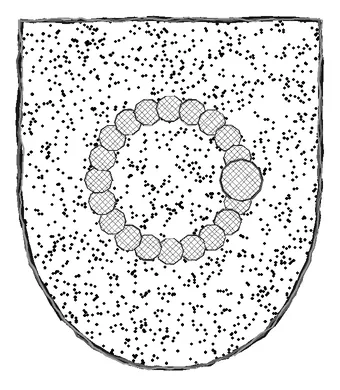
Dezau
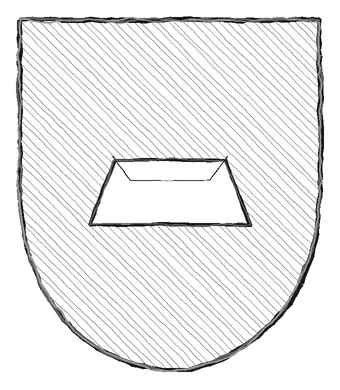
Tsehei
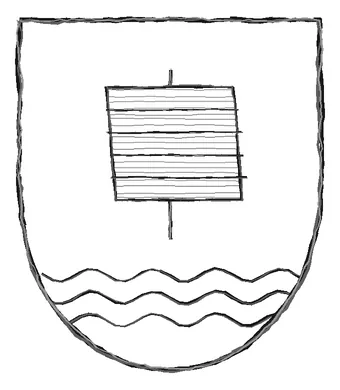
Gyonba
The houses in full: descent, heads, heirs, feuds
Succession law
The Jade Throne belongs to the Tokrai. The imperial succession law is kept in the Law Wing at Tsenkin. The Measured hold that it bars women from the throne. Princess Seitotai copied it twice in the Page Hall, and the old copyist who keeps the Page Ledger says her two copies differ by one character. The right to rule comes from the Mandate of Merit, and an emperor who rules badly can be put off the throne; the ministers deposed Tokrai Koimu in 725. Below the throne, land and goods are divided equally among sons, and daughters receive dowries. Office is never inherited, because it must be won by examination. Kaishon's great families are therefore families that pass examinations, and a family that stops passing them stops being great.
The ruling house: Tokrai
text
Dezau Kokdau, Emperor; conquers the Three Thrones, 248   (the line before the Tokrai; see Dezau)
⋮   (the chronicles do not say how the throne passed to the Tokrai)
│
Tokrai Meksi, Emperor; begins the Long Rampart, 341   (the dynasty dates from him)
⋮
├── Tokrai Tegoi, Emperor; dies six days after walking the finished Rampart, 488
⋮
├── Tokrai Koimu, Emperor; deposed under the Mandate of Merit, 725; dies copying at Tsenkin
⋮
└── (an emperor, unnamed, died 1099)
     │
     └── Tokrai Shaiku, born c. 1075, Emperor 1099   ═══  his principal consort (unnamed)
          │
          ├── (sons, none surviving)
          └── Princess Tokrai Seitotai, born 1117
- Seat: The Palace of Measured Harmony, Kokrin (
palace-of-measured-harmony,kokrin); the Imperial Heartland (imperial-heartland). - Arms: The Great Seal of the Jade Throne: the Tsenkin peaks above the Long Rampart, the disc of reason, and the four measures in the corners. The Tokrai's own device is the disc alone, red within a square seal border. Tòkrài is the Kaishoni word for sun.
- Words: Order, Merit, Reason.
- Head: Emperor Tokrai Shaiku (71), dying of an illness his physicians will not name.
- Heir: Disputed. Princess Seitotai (29) is his only surviving child. The Measured have named no male heir, and the ministries have not said which man of the Tokrai clan they would put forward.
- Wealth and power: The throne rules a realm of fourteen million souls, about 9,000,000 leusores a year, and an army of 400,000. In 1146 the ministries hold all of it, not the emperor.
- Allies and feuds: Seitotai has the Meritists, and she has courted General Dezau for six years. Grand Chancellor Makok will not let a woman hold the throne, and has said so in words that were written down.
- History: In 1139 Seitotai placed third in the examinations under a false name, and the ministers burned her paper. In 1143 the emperor withdrew and Makok took the seals of state. In 1146 the emperor gave his daughter his seal, and the ministers took it back "for safekeeping."
- Hooks: There may be two seals of the Jade Throne, and a seal-cutter has vanished. A fire in the Law Wing would destroy the succession law.
- Direction: CONTESTED.
Seiro
- Seat: The Seiro House in the Seal Quarter, Kokrin (
kokrin). - Device: A gray square seal-stone with a mark in each corner. Seirosui is the Kaishoni word for a seal of office.
- Words: The Seal Is Kept.
- Head: Grand Chancellor Seiro Makok (63), ninth Seiro to hold the seals of state.
- Heir: None who has passed the examinations. The next place in the row of brushes in the house's outer hall is empty.
- Wealth and power: The family has run the ministries for six centuries. Makok is too proud to steal.
- Allies and feuds: The Seiro lead the Measured, the ministries and the archive-city of Tsenkin. Makok has never forgiven Seitotai for making him burn her paper.
- History:
- 588–596 — Grand Chancellor Seiro Ketsan persuades the emperor to take up the Doctrine of Ordered Reason. Ten thousand monks are put to death or driven out.
- 1143 — Makok takes the seals.
- Hooks: Makok must choose an heir from outside the family. One candidate is a nephew who cheated on his examination, and Makok has shielded him for twenty years. Rúbêsèn Twelve-Times sold that nephew the essay.
- Direction: FADING.
Dezau
- Seat: The Long Rampart and its Rampart March (
rampart-march); the family's old country is the north, where the Hall of the First Measure at Tsenkin (tsenkin) keeps Dezau Kokdau's rope. - Device: A knotted measuring rope coiled in a ring, black on buff.
- Words: One Pace Is Enough.
- Head: General Dezau Honmyan (48), commander of the Long Rampart for twenty-six years.
- Heir: Not named.
- Wealth and power: Honmyan has two hundred thousand men who will follow him. He has never once thought of using them for anything but the wall, and he is thinking of it now.
- Allies and feuds: The Rampart party is his, against his will. He is loyal to the Dominion, not the Chancellor, and he is the Princess's sword if she draws it. He respects Sarsak Tolmar.
- History:
- 248 — Dezau Kokdau of the northern throne conquers the other two Thrones and founds the Dominion. The Doctrine says he measured his father's field with a rope and found the landlord had cheated by one pace.
- Hooks: Tavern talk in the Tribute Yards says Honmyan descends from Emperor Dezau Kokdau, whose line reigned before the Tokrai. No careful minister wants it looked into. The door of the Hall of the First Measure has not been opened in fifty years. Ínasôn Goat-Hand, who runs the archive's servants, heard from her grandmother that the rope rotted away, and she has told no one.
- Direction: RISING.
Tsehei
- Seat: The Southern Reach (
southern-reach), where the family's magistrate sits at Hyunei (hyunei). - Device: A silver ingot on dark green. Tsèhèi is the Kaishoni word for silver.
- Words: Silver Is Patient.
- Head: Magistrate Tsehei Kaukai (39), who takes a tenth of everything and keeps the roads good.
- Heir: Not named. Office is not inherited, and his sons must pass the examinations.
- Wealth and power: The magistrate has turned fifteen years of mahogany and pepper into jade.
- Allies and feuds: Kaukai stands with the Loosened Reins. He is terrified of the Tzalan, of an audit, and of his wife.
- History:
- 1019 — A temple-keeper named Tsehei Yotoke leads the Reasoned Rebellion. His head hangs over Kokrin's Talking Gate for a year, and every roadside shrine in the Reach holds a small clay head in his memory.
- c. 1131 — Kaukai takes the Southern Reach.
- Hooks: The Reach's peasants say the magistrate and the rebel share more than a name. A brilliant peasant girl has sat the provincial examination under her brother's name, and Kaukai must decide what to do.
- Direction: RISING, until the audit.
Gyonba
- Seat: The counting-houses of Chaiyo (
chaiyo), with a branch in Rókshái, Kokrin. - Device: A junk's sail over three waves, blue on white.
- Words: The Tide Pays Both Ways.
- Head: The eldest of the Gyonba counting-house.
- Heir: A Gyonba son who has passed the examinations, for the family keeps one in the ministries every generation.
- Wealth and power: The Gyonba live on rice broking, the Chaiyo tuna and money in the Long Market. They are the richest merchant family of the coast, and they must still step aside for any magistrate.
- Allies and feuds: The family backs the Open Gate. The Gyonba would rather trade with Sarsak Tolmar than pay him.
- History:
- 971–975 — Kaishon begins paying the Cherüsh tribute, and Chaiyo's merchants begin arguing against it.
- Hooks: The Salt Brotherhood's Long Reach crew trades at Chaiyo more often than Kokrin knows, and the Gyonba buy what it brings.
- Direction: RISING.
Kaishon's great families are CONTESTED. The Seiro have run out of sons who pass, the Dezau hold the wall, and the throne may pass to a woman the law may or may not allow.
Faith, Myth and Folkloredómecha
Myths
The Measure. By the Doctrine, Kaishon has no myths.
Myths
The Measure. By the Doctrine, Kaishon has no myths. Its own founding story is one all the same: the first Emperor, Dezau Kokdau, was a farmer's son who measured his father's field with a rope and found the landlord had cheated him by one pace. He walked to the old king's court to say so, was laughed at, and came back with an army. The Doctrine calls the rope the First Measure and keeps a rope in the archive-city that no one may see.
The Wall That Walks. The Long Rampart, the conscripts say, was not built but grew: the first stones were laid, and each night the wall walked a little farther north by itself, because it feared the steppe and wanted to reach the sea. Emperor Tokrai Tegoi walked its length to prove it was finished and died six days later, and the conscripts say the wall killed him for calling it done.
The Unseen Kin's Bargain. The countryside's telling of the Reasoned Purge: the household gods, told by the Emperor that they did not exist, agreed to stop existing on condition that they be fed anyway. They have kept the bargain. So has every kitchen in Kaishon.
Folk tales
Tsehei Yotoke's Head. The rebel of 1019, whose head was set up in Kokrin for a year and, the peasants say, kept talking: it gave the weather, named cheating mag…
Folk tales
Tsehei Yotoke's Head. The rebel of 1019, whose head was set up in Kokrin for a year and, the peasants say, kept talking: it gave the weather, named cheating magistrates, and on the last day told the crowd to go home and feed their Kin. Every roadside shrine in the Reach has a small clay head in it.
The Examiner's Cricket. A scholar sat the examinations twelve times and failed twelve times, and the cricket he kept for luck sat the thirteenth for him, in his sleeve, and passed. Told to explain any official who is stupider than his rank.
The Crane Bride. A jade crane became a woman to marry a fisherman, and left when he looked at her too long. Every pair of mandarin ducks on Lake Tsenkin is said to be a couple who did not look.
Old wives' tales
Old wives' tales
- Never step on the threshold of a house; the Door-Kin sits there, and you will have bad luck until you apologize to a door.
- A cricket that stops singing at noon means a magistrate is lying in the next town.
- Rice that boils over is the Stove-Kin complaining; add a pinch and say nothing.
- If a signal kite falls near your house, someone in it will fail an examination.
- A magpie on the left is luck; on the right is a tax collector.
- Old Tsau says: the Doctrine is right that there are no gods, and you should feed them anyway, because they are hungry.
Traditions
Traditions
- First Rice. The first bowl of every meal is set by the stove for the Kin and eaten afterward by the youngest child, "so it is not wasted." Every magistrate's household does this, and every magistrate does not see it.
- The Brush and the Bowl. A boy sitting his first examination is given a brush by his father and a bowl of rice by his mother. He takes the brush and leaves the bowl, which his mother sets by the stove until he returns.
- Kite Day. On the first windy day of spring, every village flies a kite from its highest roof, by law to honor the Rampart's signal corps. In truth the kites carry paper wishes to the sky, which the Doctrine has never quite managed to ban.
- Tsenkin Copying. Since the earthquake of 890, every scholar who visits the archive-city copies one page of something by hand before leaving. Makok has copied four thousand pages. Seitotai copied the succession law, twice.
Law and Daily Lifeshônguyò
Courts, crimes, marriage, food, dress and a day in Kaishon
Law
Kaishon's law is written, numbered and kept. The ministries write it in the Emperor's name, and the imperial house's own laws, the succession law among them, are kept in the Law Wing at Tsenkin. Every district has a magistrate chosen by examination and moved every few years so that he cannot grow roots. He wears the jade crane on his robe, every citizen begins a sentence to him with hyáu-sen ("Honored One"), and he hears every case from a stolen pig to a murder. A tenth taken in bribes is thought moderate.
Every household is entered in the register with its members, land, stove and duty to the army. The city watch is drawn from the conscript garrisons, and its true work is fire. Since 927 every stove has been registered, and inspectors look into every kitchen on the tenth day.
| Crime | Usual punishment |
|---|---|
| Petty theft, brawling | The bamboo rod, or a fine in silver |
| Gambling | Illegal; in practice a fee to the magistrate |
| Forging paper notes | The rod, and labor on the Long Rampart |
| Serious theft, assault, desertion | Labor on the Long Rampart |
| Examination fraud | The paper burned and the candidate barred for life |
| Exporting silkworms or their secret | Hanging at the Tribute Gate |
| Keeping a temple or preaching a faith | Arrest; household shrines are not seen |
| Arson | Death; no magistrate may accept silver for it |
| Rebellion | Death, and the head displayed |
Outlawry and debt. A Kaishoni struck from the register may not own land, marry, sit an examination or appear in a magistrate's hall, and many such people end among the Rampart Squatters. Debts are registered with the magistrate and pass from father to son. A debtor who cannot pay may be sent to the state workshops to work it off, and the Kilns of Kokrin are full of debtors' sons.
Family
Marriage and divorce. Families arrange marriages through go-betweens, and the marriage is entered in the register. Mandarin ducks, which pair for life, are the wedding sign. The bride's family tells its Door-Kin that she is leaving, and her new family tells its own that she has come. Neither rite is written down. Either family may petition the magistrate to dissolve a marriage, and the register records the result and never the reason.
Inheritance. Land and goods are divided equally among sons, and daughters receive dowries. Office is never inherited, because it must be won by examination, though the Seiro family has given Kaishon nine Grand Chancellors. The Measured hold that the succession law bars women from the Jade Throne.
Women. Women may not sit the examinations. Princess Seitotai sat them under a false name, placed third, and had her paper burned. Outside the ministries women run a great deal: a widow owns the largest gambling house in Kokrin, a woman keeps the Kite Terrace, and every household shrine is kept by its mothers.
Who is not free. Kaishon holds no slaves. Its conscripts are not free until their term ends, nor are men sentenced to the Rampart. The Tsenkin Hill-Folk are free because the register has never managed to count them.
Children and schooling. About one Kaishoni in three can read, and every province has state academies. A boy going to his first examination is given a brush by his father and a bowl of rice by his mother. He takes the brush, and leaves the bowl by the stove until he returns. Learning is for passing examinations.
Daily life
Food and drink. Muhau rice is boiled at every meal, and everyone drinks Shanyo tea. The first bowl of every meal is set by the stove for the Kin, and the youngest child eats it afterward "so it is not wasted."
| An official of the Seal Quarter | A porter of the Fire Wards | A rice farmer on the Muhau | |
|---|---|---|---|
| Morning | Rice porridge, pickled greens, Shanyo tea | Rice porridge and tea | Rice porridge, pickled greens |
| Midday | Rice, Tsanha sturgeon, lotus root, wine | A bowl of rice with paddy eel from a Yomìn stall | Rice and soy in the paddy, with tea from a jar |
| Evening | Rice, black Kokrin pork, coast crab in autumn, Chaiyo seaweed, wine | Rice, soy, pork on the tenth day, ale | Rice, ford carp or paddy eel, greens |
Conscripts on the Long Rampart live on rice, Rampart soy and paddy eels.
Dress and houses. Officials wear silk in the colors of their rank, and commoners wear hemp in blue and brown. Farmers live in rammed-earth houses under tile. A Fire Wards family in Kokrin lives in two rooms and shares a courtyard stove, while a Seal Quarter family has a walled compound with a pond and a household shrine that nobody calls a shrine. By law every city block keeps a well or a covered water jar.
Health and hygiene. The state keeps granaries in every province. In the Year Without Summer Kaishon opened them, and came through better than anyone. Physicians are examined like other officials. Tsenkin ginseng is worth its weight in silver, Shanyo deer antler velvet is a medicine, and Sorogei camphor keeps insects out of clothes. Bitter-bell is an old poison of the court, and there is a Kokrin herb-seller who swears a palace servant has been buying it: Tèinai the Herb-Seller (tèinai, "safe"). In the Southern Reach the magistrates pay any price for bitter-bark. Every city ward has a bath-house, entered in the fire register like any other stove.
Birth and death. A birth is entered in the register within ten days, and the Door-Kin hears the child's name before the magistrate does. The dead are buried on family hillsides, their names cut in Measures. By the ministries' reckoning a funeral is only a custom. By the family's, the dead join the Kin and are fed with them on the longest night.
Pastimes. Kaishon fights crickets, plays buitso, keeps caged cicadas, flies kites and gambles, all of it against the law or nearly so. On Kite Day every roof that can hold a child flies a kite with a paper wish tied to its string.
A day. In the cities the fire-tower drums keep the day, and in the country the paddies do. The week is ten days, and on the tenth, shôktéwâ, the shops close and every household cooks for the Kin.
Where it is going: CONTESTED. Kaishon's law is the most complete on Aethorra, and it now hangs on a succession law that may exist in two copies differing by one character. The register and the granaries will outlast any emperor. Whether the throne's law is the Measured's or the Meritists' will be settled in the Seal Quarter, and perhaps by whoever holds the seal.
Trade, taxes and money
Makes and sells. More of everything than anyone: rice, silk, porcelain, lacquer, tea, paper, iron and steel, ginseng, tuna, mahogany and pepper. Silk, tea and porcelain go west. The steel stays home, and to carry the rearing of the Tsenkin silkworm out of the Dominion is a crime against the state.
Buys. Horses, felt and hides from the steppe, and glass and medicines from the far west. Little else.
Taxes. - The rice-tax: a tenth of every harvest in kind, stored in grain-tax warehouses like those at Yomìn. - Labor service: thirty days a year from every household, on the Rampart, the canals or the roads. - The dock tax, a tenth of landed catch. It is the Chaiyo Boat-People's only tie to Kokrin. - Stall licenses in every market, held in families for generations. - The magistrate's tenth, which is not a tax, is paid everywhere, and a tenth "is considered moderate."
Paper notes are taken at full worth for small taxes and refused for large ones, and forgers in Yomìn print false twentieths because nobody checks them.
Direction. CONTESTED. The largest treasury in the One Land cannot buy an answer to who will sit on the throne.
The Year in Kaishonzanhek
Months. Nairui (kite), Kàshòkdau (tea), Sèdewek (silk), Tsau (rice), Yasâuchên (lotus), Mûhauhi (dragon-river), the month the Muhau floods, Chígútá (grain), Mèizûrûi (examination), Tápèkòn (crane), Shôktéwâ (stove), Tsentsûi (pine), Soróshài (plum blossom).
Week. Tens, as in Tharax, and for the same reason: the months divide by ten. The days are naitàu, tebui, hênmau, yóktsi, gusòn, kaudá, paken, chinshìn, keinu (one to nine) and shôktéwâ (stove), the tenth, a day of rest when the household cooks for the Kin. The Accord Days belong to no ten.
Years. Reign years. Year one begins when an emperor takes the throne, and every paper is dated from it: the 48th year of Shaiku. The ministries keep the Reckoning as well, for dealings with foreigners.
Festivals:
- Kite Day (the first windy day of spring, nearly always in Nairui). Every village flies a kite from its highest roof, officially to honor the Rampart's signal corps. The paper wishes the kites carry are not official.
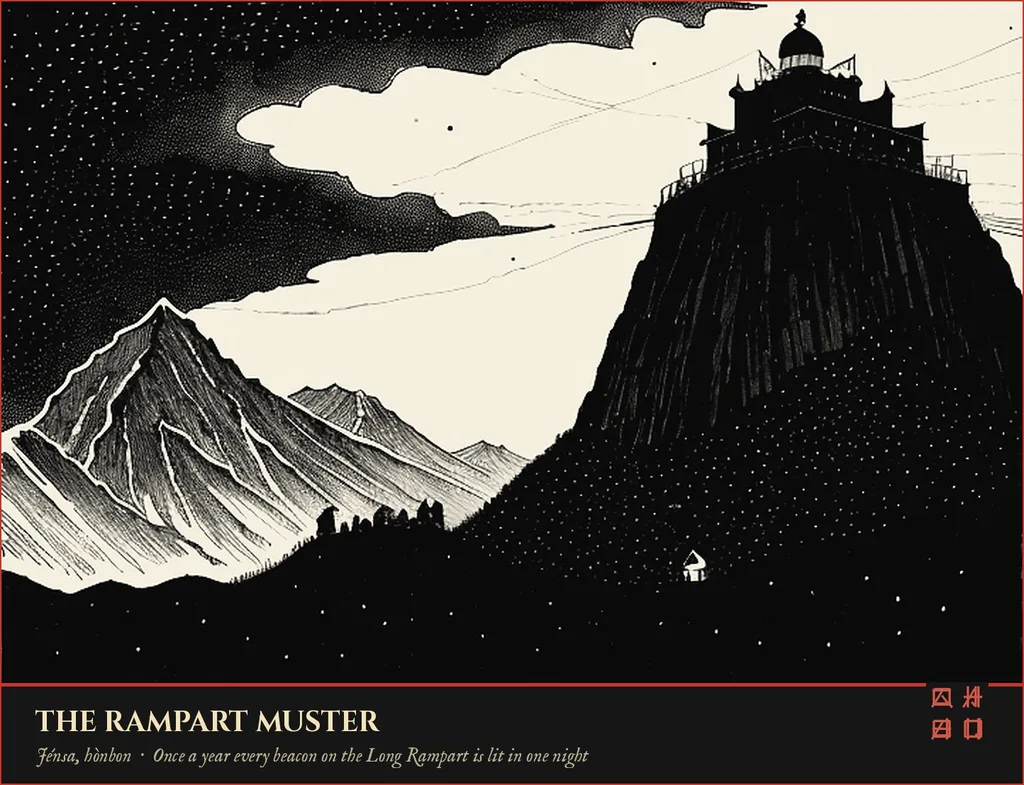
- The Rampart Muster (1st of Yasâuchên). Once a year every beacon on the Long Rampart is lit in a single night, from the Frostmarch to the Verdant Deep, to prove the signal corps still works. It has failed twice.
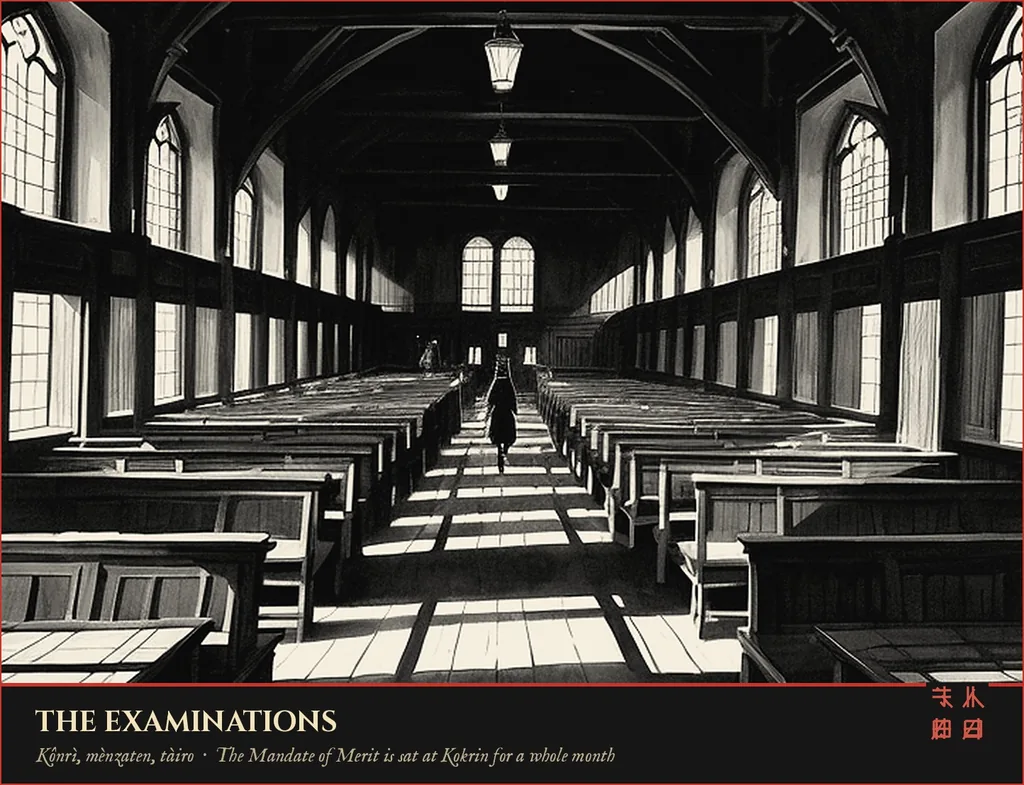
- The Examinations (Mèizûrûi). The Mandate of Merit's examinations are sat at Kokrin all month. The month is named for them.
- Feeding the Kin (the longest night, 6th of Shôktéwâ). Every household sets a full bowl before the stove for its household spirits. The Doctrine calls this a custom and not a rite, and every official's household does it.
Speak Kaishoniyaidaihya
| Kaishoni | English |
|---|---|
| Hyáu-sen, shau-mi kèktèi. | Honored One, this small one comes. (The correct way to enter a magistrate's hall.) |
| Ketsán, kônrì, tàiro. | Order, merit, reason. (The motto of the Doctrine.) |
| Meksi kwanmon? | Where is the Rampart? (Question words need no particle.) |
| Tsei tsò kézu. | I don't know. |
| Kwímói chonón radáuho? | How much money? |
| Tsò myókra. | There are no spirits. (The Doctrine's creed, said flatly. Literally "no spirit.") |
| Dutó shôktéwâ. | Feed the stove. (What the countryside says instead. Literally "give the stove.") |
| Yàu tónba mèizûrûi myòk? | Have you passed the examination? (The only question that matters. Literally "you finish examination?") |
| Téirokjû háuchò giwe. | The mandate is with the Throne. (Said at every court ceremony; said in the Reach with a shrug.) |
| Sènhyo koimu, pínsònkó. | People are quiet at night. (A saying about the Reasoned Purge, never explained.) |
| Hênmau áumè chontatsa | three horses (literally "three head horse") |
| Tebui bichondi ròtonyó | two letters (literally "two sheet letter") |
| Tsei jek jauhû | my house (literally "I of house") |
| Kaishoni | English |
|---|---|
| raihochu | person |
| tánbôshék | father |
| hòkrai | husband |
| bànrek | king |
| dutèi | farmer |
| tòkrài | sun |
| kyòsíshâu | wind |
| kíngyon | lake |
| módói | wood (material) |
| ganzanrai | town |
| tokra | door |
| gyárêirù | day |
| yateicha | spring |
| sèipo | bread |
| zenmàn | wine |
| kûizínba | dog |
| óbék | bird |
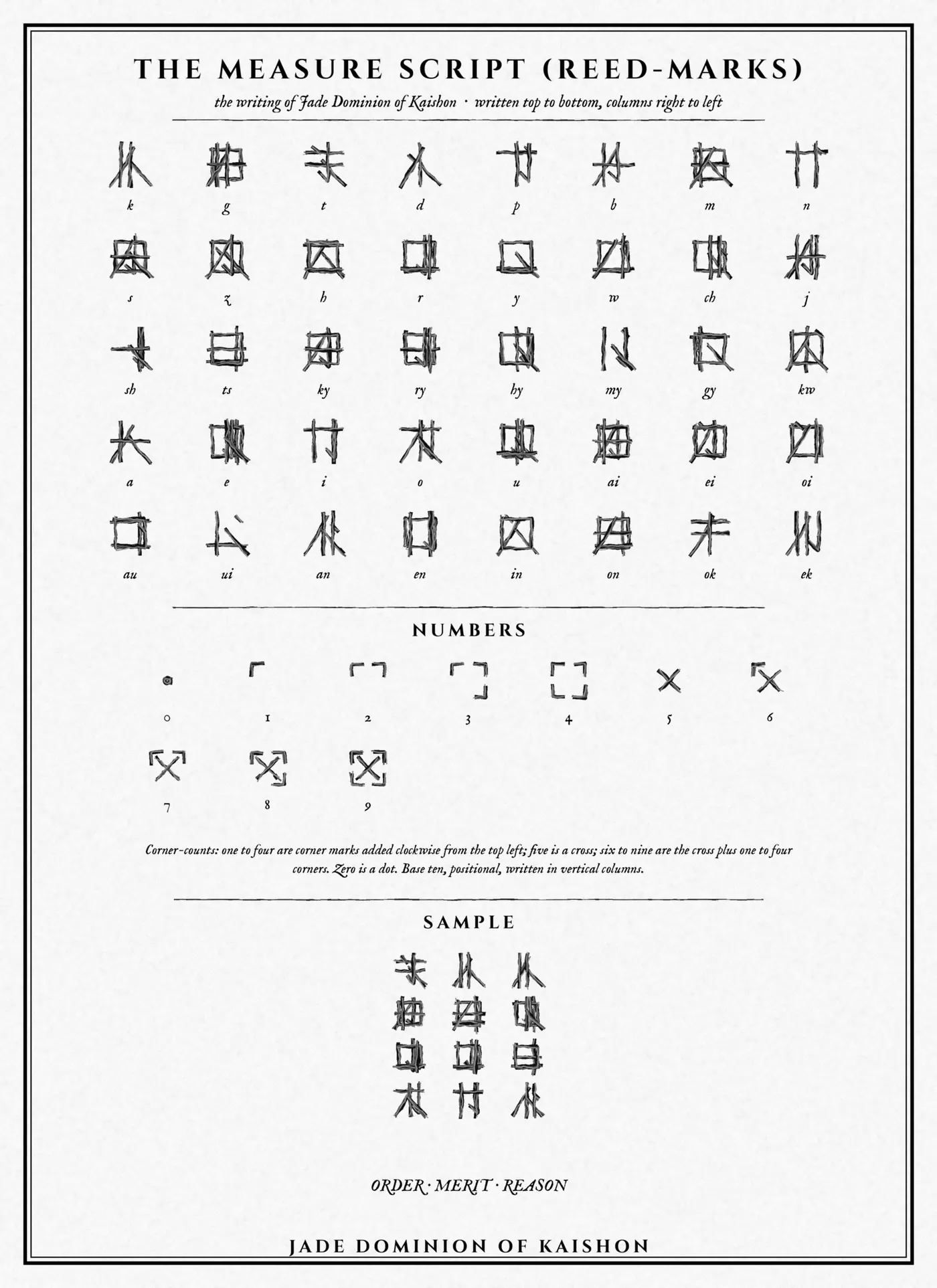
A Thousand Yearstautsá
| Year | What happened |
|---|---|
| 0 R. | The Accord of Surmave. The six surviving great powers and the Tharaxi sign the Accord on an island in Lake Surmave, fixing borders and founding the calendar: Vareth, Wessary, the Marrowmere League, the Twin Crowns of Castavar and Lasdara, the Sarvani Khaasarate, the Three Thrones of the East, and Tharax. Hrodvald sends no envoy and signs nothing. |
| 0–146 R. | The Accord holds. The Accord holds, mostly. Vareth and Wessary spend the first century marrying into each other's royal houses. The Sarvani Khaasareem dig the first great salestoot. The Three Thrones fight each other every generation. Tharax, having lost half its citizens in the Century of Fire, rebuilds the Anvil. |
| 248 R. | The Founding of Kaishon. In the East, Emperor Dezau Kokdau of the northern throne conquers the other two Thrones and founds the Jade Dominion of Kaishon. He institutes the first examinations for office in 260. |
| 260 R. | The first examinations. Emperor Dezau Kokdau institutes the first examinations for office in Kaishon. |
| 341 R. | The Long Rampart begun. Kaishon begins the Long Rampart under Emperor Tokrai Meksi, after steppe raiders sack Sorogei. |
| 461–470 R. | The Rampart War. The Rampart War. Tontanor attacks Kaishon's unfinished wall for nine years. Kaishon loses a hundred thousand conscripts and holds. The war teaches Kaishon to build the repeating crossbow. |
| 471 R. | The Rampart Marriage. The Rampart Marriage. A year after the Rampart War ends, Kaishon buys peace with a marriage: Princess Tokrai Hyuha marries Iygar, son of Shaghis the Gray, at the Tontanor fords. Her clerks teach the Charnazin to count horses. Kaishon has never married out since, and the Measured strike the marriage from the register in 503. |
| 488 R. | The Long Rampart completed. The Long Rampart is completed, 1,100 miles from the Frostmarch to the edge of the Verdant Deep. Emperor Tokrai Tegoi dies six days after walking its length. |
| 505–509 R. | The Emptying of the West. The Emptying of the West (Sheti Tsanha). Emperor Tokrai Tsonda orders the steppe cleared for three days' ride in front of the Long Rampart. General Dezau Nogowei's columns burn empty tents for four years; the grass fired in 507 burns back along the ditch and takes the wall's own hoardings; a column of eight thousand sent after the Saiga Followers in 508 is led in a circle by its Nintang guides and half of it dies. Grand Chancellor Seiro Hishei's memorial of 509 ends the measure on the emperor's death. The Nintang, half Kaishoni by the conscripts who stayed, and the Rampart Squatters, who moved one li west and called themselves 'not present,' date from it. The steppe calls it Ghorsot Zaghisrat, the Grass Burned. |
| 588–596 R. | The Reasoned Purge. The Reasoned Purge. In Kaishon, Grand Chancellor Seiro Ketsan (ancestor of the present Seiro Makok) persuades the emperor to adopt the Doctrine of Ordered Reason as state creed and outlaw temples. Ten thousand monks are executed or exiled. Kaishon has been officially without gods ever since. The old faith survives in the household spirits of the countryside. |
| 623 R. | The Year Without Summer. The Year Without Summer. Crops fail across Aethorra. The Frostmarch, the Heartlands and the Sunmaw all starve. Kaishon opens its granaries and survives better than anyone. The Hizkari, who lived on the slopes, become a hardened remnant people. |
| 626–627 R. | The Rice March. The Rice March. In the Hunger Wars, General Dezau Kyarau leads thirty thousand conscripts out of the Jade Gate to escort Kaishon's rice convoys west and collect Caelvenne's silver. At the Tontanor fords, on the League's Day of the Accord Days, his repeating crossbows kill some three thousand Aldmeri levies and Caelvennois marines who had been taking the rice; that night the steppe tribes take it. Kyarau marches home in 627 with the silver, the only Kaishoni army to stand west of the Rampart since the Emptying. In the same season the Zarvani burn a Castavari column with naphtha on the salest channels below Kebidaan, the first Talodin fire. |
| 631 R. | The Peace of the Isle. The Peace of the Isle ends the Hunger Wars. The envoys of the six signer-realms meet on the Isle of the Accord in the Accord Days, the first time since 0 R. Five terms: a signer whose army crosses a border in the Accord Days loses its chair at the Isle for seven years, and Kaishon sits out the first penalty; no realm's soldiers may seize a Qaflan wheel or a Drift keel, the Road Terms; each signer sends an envoy every year to hear the Accord read, the seed of the Sitting; grain in transit is not spoil; and a price is not an act of war. Hrodvald is not asked. |
| 641 R. | The Charter of Hearths. Aldmere's Charter of Hearths, signed by King Hethwur IV, guarantees freedom of worship in the kingdom. Refugees from the Reasoned Purge and the Berrode's inquisition settle in the Heartlands. |
| 725 R. | Emperor Tokrai Koimu deposed. Kaishon's Emperor Tokrai Koimu is deposed by the ministers under the Mandate of Merit for "negligence," the first and only time it has happened. He is sent to the archive-city of Tsenkin, where he dies copying manuscripts. |
| 763 R. | The Barerk Raid on Shanyo. The Barerk Raid on Shanyo. Hrodvald longships row down the northeast coast and sack Kaishon's northern city. Kaishon extends the Rampart's northern forts to the sea. |
| 801 R. | The Black Autumn. The Black Autumn. A blight destroys the Heartlands wheat crop. Aldmere borrows a fortune from Caelvenne to buy Kaishoni rice. The Grain Compact debt doubles. |
| 890 R. | The Tsenkin Earthquake. The Tsenkin Earthquake. Lake Tsenkin's shoreline collapses; the archive-city loses a third of its manuscripts. Kaishon spends forty years recopying what survives. |
| 899 R. | The Ledger Peace. The Ledger Peace, sworn on the Isle of the Accord in the Accord Days after a year of Qaflan wheel-letters, with Kaishon's ambassador as go-between. The Grain Compact is restored word for word and the measure is to be set each New Year's Day by Moot and Conclave together; the barges of 892 are paid at the Compact price and the Drift paid a leusore a keel for Threeoars; Castavar's chair at the Isle, empty since 895 for crossing into Daalher on the Khaasar's Day of 894, stays empty to 901 and Castavar swears the Peace standing and gets nothing else; Zarvand keeps Daalher and doubles its gate; Tharax takes its twenty years of grain and resolves never to be paid in gold, a resolution kept until 1131; and the Qaflan and the Drift are given a bench in the Sitting's hall to swear the Road Terms on, which becomes the Bench of the free peoples. Princess Somith Tulvard marries Prince Corenvo of Castavar to seal it. The sentence assigning the banks of the Tsanha fords is written badly, and the War of the Tsanha Fords is fought over it in 911. |
| 927 R. | The Great Fire of Kokrin. The Great Fire of Kokrin. A third of the capital burns. The rebuilt city is laid out on the grid it has today. |
| 971–975 R. | The Cherüsh Ascendancy. The Cherüsh Ascendancy. The Cherüsh tribe conquers its neighbors on the Grass Sea and becomes the largest steppe tribe. Kaishon pays the Cherüsh olriqtun tribute to keep them off the Rampart, a practice that continues to this day and that Kaishon's ministers call "gifts." |
| 1019 R. | The Reasoned Rebellion. The Reasoned Rebellion. Peasants of Kaishon's Southern Reach, led by a temple-keeper named Tsehei Yotoke, revolt to restore the old gods. Kaishon crushes it with the Sorogei garrison. Tsehei Yotoke's head is displayed in Kokrin for a year. Household shrines are quietly tolerated afterward. |
| 1074 R. | Sack of a Zarvani spice-fort. Tzalan warriors sack a Zarvani spice-fort on the Nhal. Zarvand and Kaishon both begin pushing garrisons into the Verdant Deep. |
| 1082 R. | The Cherüsh Civil War. The Cherüsh Civil War. The Cherüsh olriq is murdered by his brother; the tribes split into four factions and fight for a generation. Kaishon stops paying tribute. Aldmere's eastern border is quiet for the first time in a century. |
| 1099 R. | Tokrai Shaiku takes the Jade Throne. Tokrai Shaiku takes the Jade Throne at 24 after his father's death. |
| 1117 R. | Tokrai Seitotai born. Tokrai Seitotai is born to Emperor Tokrai Shaiku's principal consort. The emperor has no surviving sons. |
| 1138 R. | Selra's raid on Shanyo. Selra Stormbrand's longships raid Shanyo on Kaishon's north coast, the last great Hrodvald raid of any kind. |
| 1141 R. | Sarsak Tolmar unites the Cherüsh. Sarsak Tolmar, 22, unites the four Cherüsh factions after killing the last rival olriq in single combat at the ruins of Tontanor. He pitches his camp on the old capital's ruins and names it Tolmar-Buyor. Kaishon resumes tribute payments at once. |
| 1143 R. | Makok takes the seals. Emperor Tokrai Shaiku falls ill and withdraws from public view. Grand Chancellor Seiro Makok takes the seals of state. |
| 1145 R. | The saddle on the Bench. In the Accord Days that close 1145, Sarsak Tolmar sends a rider, Kholab, to the Sitting at the Isle, the first Cherüsh envoy in six centuries. Kholab refuses the Bench and demands a chair as the Charnazin's heir; the Sitting refuses, since the Charnazin never signed the Accord. He leaves his saddle on the Bench and rides for the fords. The same Sitting hears the Khaasar's letter of 1137 read into the record without reply from Tharax, the bishop's sermon on the Fourth Crusade, and Selra Stormbrand's letter asking for the Absent Chair, answered as always. Nothing is settled. |
Dispatchessonhainu
From 1 January 2027 the Reckoning runs day by day, and news from Kaishon arrives here as it happens: who rode where, who fell, who lied at council.