


Solvaine
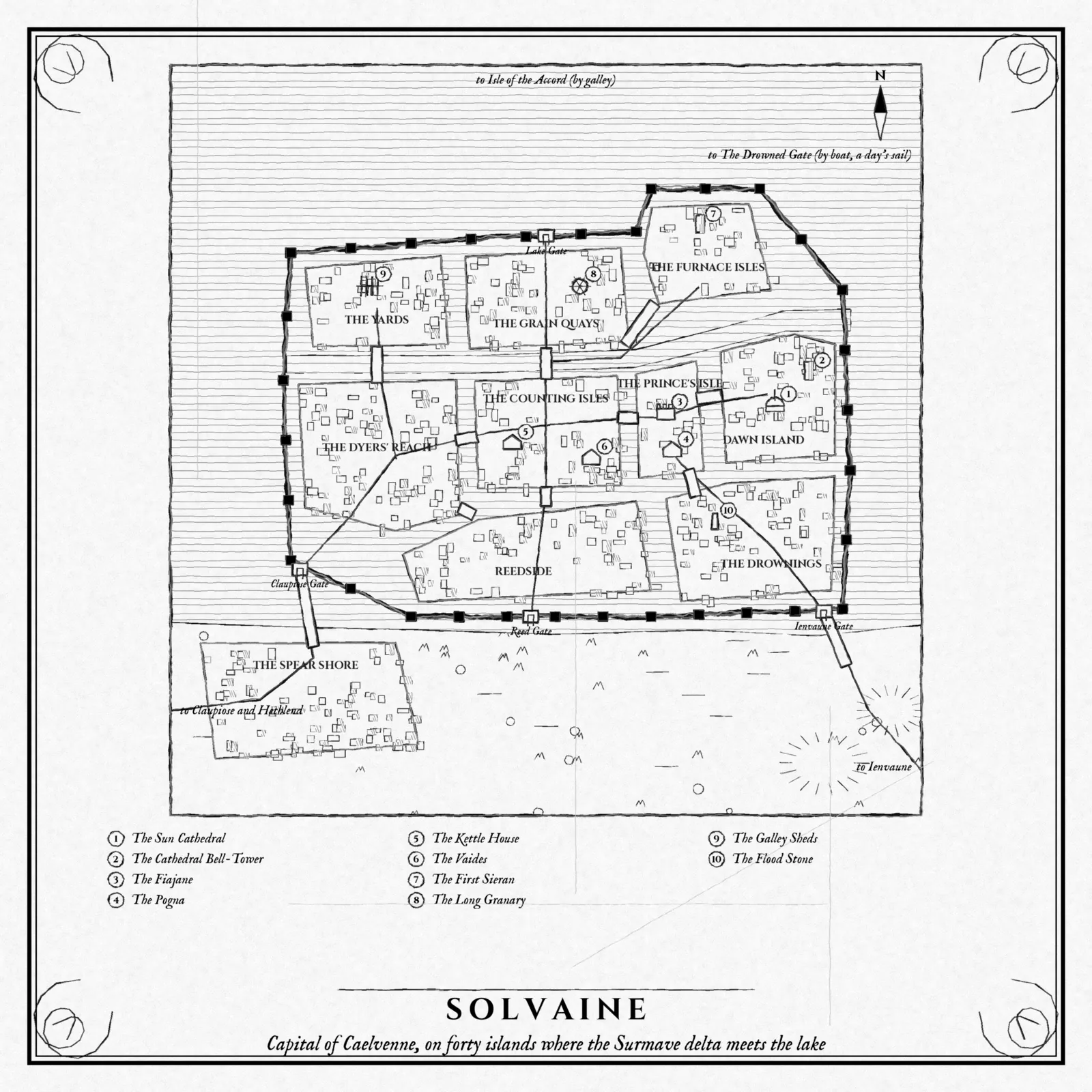
Capital of Caelvenne · about 190,000 people
From Claupiose, the road runs out before the city begins. The last mile is a causeway of brick piers across the reed marsh, and from its crown at dawn the whole city rises out of the water at once: forty islands packed with painted walls, arcades and bell towers, the canals running between them in dark green lines, and over all of it the golden dome of the Sun Cathedral taking the first light off Lake Surmave. On the eastern islands a mirror tower answers the sun with a flash of its own. There is no thatch anywhere. Every roof is tile, and every wall is painted rose, ocher or lily white.
The noise comes before the smell. Every bell in the city rings for the dawn liturgy, and under the bells come the boatmen's calls at the canal corners and the knock of oars on stone. Then the wind brings the rest: lake water and weed, woodsmoke from the glass furnaces, a thread of rose perfume, and Zarvani coffee, brewing in every house that can pay for it, because its eldest has just opened the eastern shutter and said, "The debt is paid."
At a Glance
At a Glance
| Population | About 190,000 on forty islands, with a few thousand more on the Spear Shore outside the walls |
| Ruled by | Prince Lourien diol Valcroix (61, elected 1132) and the Conclave of Nine Houses, which elects him |
| Walls | A brick-and-marble wall around the outer islands, four gates, and a chain across the harbor mouth; the Tharaxi garrison camps outside it |
| Water | Rain cisterns under every square and spring water brought by boat from the villa hills; nobody drinks the canals |
| Lives on | Money-lending, glass and mirrors, dyed silk, perfume, printing, clockwork, jewelry, painting and the lake trade; eats Aldmere's grain |
| Faith | The Church of the Radiant Iévaine; the Ledger among clerks; the Drowned Court among fishermen and glassworkers |
| Tongues | Caelvennois; Aldmeri on the grain quays; Tharaxi on the Spear Shore; Castavari, Zarvani and Maved in the counting-houses |
| Coin | Gold leusore and silver flirone, twenty flirones to the leusore; every other coin on the continent is changed here |
| Known for | The golden dome, the Nine Houses' banks, mirror glass, the mirror towers, the Quiet Office, the Bells |
| Direction | CONTESTED |
History in Brief
History in Brief
- Before the Reckoning — The Builders' greatest city drowns when the lake rises about sixty feet. Its streets and stepped water-gate lie in the lake off Solvaine.
- 0 R. — The Marrowmere League, Solvaine among its cities, signs the Accord of Surmave on the Isle of the Accord.
- 220 — Solvaine, Claupiose and Ienvaune found the Lake Treasury to pay for a galley fleet.
- 255–294 — The Marrowmere Wars over lake tolls. In 271 Claupiose's galleys burn Ienvaune's harbor.
- 294 — The Peace of the Nine makes Fezaud diol Valcroix prince, names the realm Caelvenne, and founds the Conclave of Nine Houses.
- 367 — The Lake Comet hangs over the lake forty nights. The sun-priests call it Iévaine's favor and build a cathedral; local lore says the dome's first gilding was paid for that winter.
- 421 — The first leusore is struck, and the banks take up the ledger figures.
- 511 — The Grain Compact: Aldmere feeds Caelvenne, and Caelvenne lends to Aldmere.
- 539 — The Great Surmave Flood raises the lake twelve feet and drowns the lower city. The falling water uncovers the Drowned Gate.
- 603 — Prince Roltien diol Valcroix is stabbed at dawn prayers in the Sun Cathedral. The Conclave hangs the Aijal patriarch and two of his sons from the bell-tower.
- 788 — Sierine Tésvol builds the first mirror tower line across the lake. Within twenty years Solvaine can signal Larvir faster than a rider can saddle.
- 903 — The glass-merchant's widow Vailine Farisel founds the House of Farisel.
- 949 — The Conclave hires Tharaxi spears for the lake shore, on condition that no Phymon sleep inside the walls.
- 1068 — The Solvaine Bank Panic. The House of Tésvol fails, and lives on only by marrying into Farisel.
- 1131–1135 — The Iron Contract with Tharax (1131), Lourien's election (1132) and the Gilded Pact with Castavar (1135).
- 1146 — Farisel stops lending to Castavar. Cherüsh riders are seen at the Tsanha fords. The Iron Contract lapses next year.
- Local lore, undated — The Pile-Masters' rule that no new island is begun on a cloudy day, so the Sun can witness the first pile.
The Layout
Solvaine stands at the southern edge of Lake Surmave, where the reed islands of the delta meet open water.
The Layout
Solvaine stands at the southern edge of Lake Surmave, where the reed islands of the delta meet open water. The lake lies north and east, and reed marsh runs south to the mainland. Every island stands on oak pilings driven through the reed mud, and every street is a canal or a walkway beside one. The widest channel, the Pavir ("canal"), runs west to east through the city and parts the harbor islands of the north from the old heart. Some four hundred bridges join the islands. The wall has four gates: the Lake Gate at the harbor chain, the Claupiose Gate and the Ienvaune Gate at the two causeways, and the Reed Gate on the marsh. There are no horses and no carts inside the walls. Goods go by boat, and people walk or pay a boatman.
The Grain Quays. Three broad islands behind the Lake Gate, where the grain barges come in from Aldmere down the Claurou, as Solvainers call the Wenvorm, and across the lake. The quays are cut stone, rebuilt in living memory and already rounding at the edges. The warehouse cats hunt the gray rats that came with the barges. Aldmere's bargemen keep a small hearth-house here. At the head of the Grain Stair the quay-masters chalk the day's bread price in ledger figures, and the Bells read that board before anything else.
The Yards. Four islands in the northwest where the lake navy is built and wintered: galley sheds, ropewalks, oar-makers and pitch-boilers. The officers are cardinals' nephews who frown on the Drowned Court, yet every galley here carries a knotted cord on its bow, and no officer has ordered one cut. Moored offshore are the Debtors' Hulks, two old galleys where men who cannot pay sit until their families do.
The Furnace Isles. Six small islands in the northeast, kept apart because the glass furnaces burn day and night. The jewel-green Solvaine glass-fly swarms over these canals. Glassblowers, mirror-silverers and lens-grinders live here beside the workshops of the engineers' bench. Most glassworkers are Drowned Court, and the island shrines carry knotted cords beside the sun-disc.
The Counting Isles. Seven islands of marble and arcades in the center, where the Nine Houses keep their counting-houses. It is the quietest quarter in the city: pens, abacus beads, and the flat speech of contracts that Solvainers call nélognel. Money-changers sit under the arcades with tables for turning every calendar and coin on the continent into every other, and the block-and-screw printers of Coin Row print price sheets and bills of exchange. On Gresil, the sixth day, the banks close.
The Prince's Isle. One large island east of the Counting Isles, holding the Fiajane, the Pogna and the ambassadors' houses. Lilies in enameled armor stand guard on foot, because their horses are kept on the mainland. The pigeon lofts on the palace roofs belong to the Quiet Office, which by its own word has no address. An ambassador comes by boat to the palace's one water door and waits on a bench built to be uncomfortable.
Dawn Island. The easternmost island, given to the Sun Cathedral, its bell-tower, its school and the cardinal's household. The cathedral square opens east onto the lake. Pilgrims and indulgence-sellers crowd it before dawn. The poor-fund's bread is handed out from a side door, and the line forms before the liturgy ends.
The Dyers' Reach. Five islands in the west where Claupiose silk is dyed and finished and perfumers boil villa roses and shore lavender. The vats turn the channels red, blue or saffron by turns, and the eel-trappers downstream swear they can taste the day's color in the eels. This is the Bench's stronghold.
Reedside. Six low islands on the southern edge, facing the marsh. Reed-cutters, eel-trappers, porters, boatmen and washerwomen live in tile-roofed timber houses on short piles and cut reed for mats and baskets, never for roofs. Delta ibis stalk the mudbanks, and in bad summers the delta mosquito brings the lake fever here first. These are the Bells, and their one rule is that nobody rings alone.
The Drownings. Seven islands in the southeast over what is left of the lower city the flood destroyed in 539. The lake went back down, but the lower city never came back up: pilings had shifted and whole islands had scoured away. What was rebuilt is a fishermen's quarter of stilt houses over old stone, and at low water the doorsteps of the drowned streets show under the boats. Nobody swims here after dark, and at each new moon the fishing boats leave before dusk for the Drowned Gate.
The Spear Shore. The mainland outside the southwestern wall, where the Claupiose causeway comes ashore: carters' yards, the horse market, inns for travelers who arrive after the gates close, and the Spear Camp of the Tharaxi garrison. Every evening the Tharaxi on duty inside march out through the Claupiose Gate before sunset. Solvainers call it the Sunset Walk, and children march beside them in step, which the Tharaxi pretend not to see.
Landmarks
The Sun Cathedral. The great church of the Radiant Iévaine, whose golden dome can be seen across the lake at dawn.
Landmarks
The Sun Cathedral. The great church of the Radiant Iévaine, whose golden dome can be seen across the lake at dawn. It faces east so that the Sun's daily repayment of its debt can be witnessed, and inside it is lined with mirrors and gold leaf for dawn processions, choirs and incense. Solvaine lenders will not sign a contract on a day the dome is in cloud, because the Sun is not watching.
The Cathedral Bell-Tower. Its bells ring the liturgy, and when bread runs short the poor ring them for themselves. In 603 the Conclave hanged the Aijal patriarch and two of his sons from it. The taverns still sing a song about it, and the old wives' rule is never to hum it near an Aijal.
The Fiajane. The prince's palace, named for the lily ("fiajane") of the Valcroix badge. All agree its dining hall has seen more treaties broken than signed.
The Pogna. The hall of the Conclave ("pogna"), where the Nine Houses meet and elect the prince. It has nine doors, one for each house, and a tenth that is bricked up. The Bench says the tenth door is theirs.
The Kettle House. The counting-house of the House of Farisel. A plain copper kettle stands in a glass case in its entry hall, and the bankers' toast, "to the kettle," is drunk here first. On Kettle Night, the day Vailine Farisel died, the Nine Houses count their books by candlelight in silence, and the youngest clerk reads the total aloud.
The Vaides. The old hall of the Lake Treasury of 220 ("vaides," treasury), and the mint where the first leusore was struck in 421. Every leusore is still struck and weighed here.
The First Sieran. The Solvaine head of Sierine Tésvol's first mirror tower line of 788 ("sieran," mirror tower), on the tallest of the Furnace Isles. Its bronze mirrors flash to Larvir and the far shore, and Sierelle Tésvol keeps her workshop at its foot. A mirror tower flashing at night with no message, the old wives say, means the Quiet Office has lost a man.
The Long Granary. A warehouse on the Grain Quays holding the city's store of Aldmere wheat. When its doors stay shut on a market day, the Bells start climbing the tower.
The Galley Sheds. The covered slipways of the Yards, where Caelvenne's lake galleys are built and wintered.
The Flood Stone. A marble column in the Drownings, marked in the Cathedral Hand with the height the water reached in 539, twelve feet above the lake's common level. Fishermen touch it for luck before they sail to the Drowned Gate.
The Drowned Gate. A stone arch of the Age of Ruins in the southern waters of the lake off Solvaine, a day's sail northeast of the Drownings, uncovered by the Great Surmave Flood of 539. It is the holiest place of the Drowned Court, whose faithful leave offerings there at the new moon. Its diving priests, the Gatekeepers, claim to have touched the sunken roads below, and they have brought up bronze.
The Isle of the Accord. The island where the Accord of Surmave was signed in 0 R., two days north of the city by galley. In the common telling, nine sisters swore the Peace of the Nine there on a mirror in 294. Its Accord clams give small, prized pearls, and every Solvaine jeweler keeps a tray of them.
Government, Law and the Watch
The Conclave of Nine Houses sits in the Pogna, chooses the prince from among its families, and shares out the city's islands among its houses as wards.
Government, Law and the Watch
The Conclave of Nine Houses sits in the Pogna, chooses the prince from among its families, and shares out the city's islands among its houses as wards. Each house keeps watchmen on its own islands, lights its own lamps and settles small quarrels in its own counting-house. Farisel, Valcroix and Tésvol are three of the Nine. The Valcroix have held the princely seat most often, but never by right.
The Lilies guard the prince and his island. The Tharaxi guard the shore and the gates by day and are gone by sunset. The Quiet Office, under Roltien Aijal, watches everyone, the Lilies and the Tharaxi included; its messages travel by Solvaine pigeon in a cipher built on the Solvaine Hand.
Law in Solvaine is mostly the law of contracts. A contract is signed under the Sun, in daylight, never under a clouded dome. Interest falls due on the four Settling Days. The year's books close on Closing Day, and in the Accord Days that follow no debt may be called in and no court sits, a rule Caelvenne holds the whole continent to. A debtor who cannot pay goes to the Hulks, a thief pays back twice what he took, and a forger of the leusore is drowned in the harbor with his coins sewn into his coat.
Trade and Work
Solvaine makes almost nothing anyone eats and almost everything anyone wants.
Trade and Work
Solvaine makes almost nothing anyone eats and almost everything anyone wants. The Counting Isles lend to four of the seven great powers and to half the Nine Houses. The Furnace Isles make mirrors, window glass, lenses and the mirrors of the towers. The Dyers' Reach finishes Claupiose silk and bottles perfume. Clockwork engineers build mechanical crossbows and self-winding siege engines. The guilds of glassmakers, dyers, engineers and boatmen are the spine of the Bench.
Everything else comes by water: grain from Aldmere, Castavari red from the Llovo, white wine from Ienvaune, coffee from Zarvand at ruinous cost, white Nugag fox pelts from the Frostmarch, and whitefish, perch and delta eels from the lake. The lake sturgeon and the mirror swan are kept for the prince's table.
What things cost (in a year when the Bells are quiet): - Aldmere wheat bread: ten loaves for a flirone, six when the grain is late - Surmave whitefish: three for a flirone - Zarvani coffee at a quay stall: four cups for a flirone - A boatman's fare between two islands: twenty fares for a flirone - A porter's day's work: one flirone - A good meal and a bed at a Spear Shore inn: one flirone - Ienvaune white: two jugs for a flirone; Castavari red costs a third more - A hand mirror of Solvaine glass: two leusores - A bolt of dyed Claupiose silk: six leusores - A small indulgence at the cathedral door: one flirone
Daily Life
The day begins with First Light: the eldest opens the eastern shutter and says "The debt is paid," and the bells answer from Dawn Island.
Daily Life
The day begins with First Light: the eldest opens the eastern shutter and says "The debt is paid," and the bells answer from Dawn Island. Then comes coffee for those who can pay and bread for everyone else. The counting-houses open at full light and close at dusk, because nothing is signed in the dark, and deals are struck over long lunches in the arcades.
The six-day week runs Siale, Bove, Fiane, Glaure, Saive and Gresil. People eat whitefish, eels and Aldmere bread, and Ienvaune pastries on feast days. Anyone who can manage it wears silk, and men and women alike wear scent. Houses are tall, narrow and painted, with a water door below and a land door on the walkway, and nobody sleeps on a ground floor that floods every wet spring. Galley crews race on the Pavir after each Settling Day, and the city bets on them. Girls of the houses float a lily on the lake at sixteen, and if it comes back they will marry within the year; half the houses keep a servant with a boat and a hook for the purpose. Couples marry facing a mirror, not each other, and a house's secret mirror-name, its ètinvime, is spoken only then.
Festivals. The Settling Days fall on the 1st of Punsimor, Clauve, Caudés and Jende. The first is New Year's Day, when the year's Iron Contract gold leaves the Vaides under guard for Tharax. The Radiant's Sermon, on the 3rd of Clauve, the longest day, is preached against the Ledger while the Nine Houses sit in front and their bookkeepers stay home. On the Night of Mirrors, the 9th of Surmave, every lakeside house sets a mirror and a lamp in a window facing the water, and from a boat the city is lit twice. Kettle Night keeps the day of Vailine Farisel's death. Closing Day, the 30th of Gresil, ends the year's books, and the Accord Days follow. At every new moon the Drowned Court's boats sail for the Gate. In high summer the Surmave midges drive the Nine Houses to their villas at Ienvaune, and for a few weeks the city belongs to the people who live in it.
Faith
About seven Solvainers in ten follow the Radiant Iévaine, who borrowed gold from the earth to make the dawn and repays it each morning by pouring light onto the lake.
Faith
About seven Solvainers in ten follow the Radiant Iévaine, who borrowed gold from the earth to make the dawn and repays it each morning by pouring light onto the lake. Every island has a small church with a mirror over the altar. Cardinals and canons come from the Nine Houses and live like princes. Cardinal Fezaud Lalos sells indulgences and takes the houses' bribes, yet he fought Prince Lourien three years to keep the poor-fund from being lent at interest.
The Ledger is the clerks' faith. Its followers read their private ledger of deeds every seventh night, and since the Caelvennois week has six days, that night walks through the week. The Church calls it a heresy once a year and puts it to work every day.
The Drowned Court belongs to the Drownings and the Furnace Isles. Its faithful believe the Builders sleep in a city beneath the lake, dreaming Solvaine, and will take the city back when they wake. The cardinals call it a fishwives' superstition and leave it alone, because the Gatekeepers are the only divers who will go down to the sunken roads, and the Nine Houses want to know what is there. Bevele Bansine Farisel's late husband was a Gatekeeper. Aldmere's bargemen keep the Hearthfaith, and many engineers are quiet Reasoners who come to the liturgy for the music.
Crime and the Underside
A city of bridges and no streets is built for smugglers.
Crime and the Underside
A city of bridges and no streets is built for smugglers. Coffee, pelts and Castavari silver slip past the customs through the reed channels south of Reedside, and the Drift's lake barge-town, Surmave Float, carries whatever the customs boats miss. Boat-thieves work the canals at night, and clipped leusores turn up in Reedside taverns. The old wives say a leusore found face-up in a canal must be spent before dusk, or it will spend you.
The Quiet Office knows most of this and uses it: a boatman who carries the Office's letters is never searched. The Bells are the underside everyone watches. Cardinal Lalos feeds them, Aijal watches them, and Farisel prices them into every grain loan. When the bread board shows a bad number two days running, the Reedside boats drift toward Dawn Island and the Lilies move to the Prince's Isle bridges.
People of Note
People of Note
- Prince Lourien diol Valcroix (61) — Prince since 1132, collector of paintings, and the most dangerous man on Aethorra to sit across a dinner table from.
- Bevele Bansine Farisel (49) — Head of the House of Farisel, who has cut off Castavar's credit this year.
- Roltien Aijal (44) — Master of the Quiet Office and last heir of the house hanged from the bell-tower.
- Cardinal Fezaud Lalos (66) — Prelate of the Sun Cathedral, whose bass fills the dome at dawn.
- Sierelle Tésvol (26) — Engineer of the mirror towers and the Bench's unlikely darling.
- Queen Rorelle diol Valcroix (28) — Lourien's niece, Queen of Castavar, who never lost her Solvaine lilt.
- Glequen the Pile-Master — Master of the piling crews, who writes down every place a pile strikes something hard deep in the reed mud. ("glequen," stone)
- Iaza the Gatekeeper — The oldest diving priest in the Drownings, a gray-haired woman in her fifties who still dives at the Gate on calm new moons. ("iaza," moon)
- ("numive," remember)
- Mèsdas the Bellringer — The cathedral's chief ringer, born in Reedside, who has never locked the tower door on a bad bread day. ("mèsdas," song)
- Dorille the Ferrywoman — Runs the night ferry to the Spear Shore and knows which Tharaxi drink and which write home. ("dorille," luck)
Rumors and Story Hooks
Rumors and Story Hooks
- Glequen's book shows hard bottom under Dawn Island at the same depth every time. Nobody has ever asked what the city stands on, and someone has just offered to buy the book.
- The Drownings say the lake stands a hand higher at the foot of the Flood Stone than at New Year, with no more rain than usual. Iaza has stopped diving.
- Numive's poor-fund books balance too well. Someone has lent the fund at interest to a Tésvol.
- Kaishon's ambassador has taken Sierelle Tésvol to lunch three times this month, and so has a Farisel cousin.
- A Ledger-following clerk of the Kettle House has died, and his private ledger of deeds is missing.
- The First Sieran flashed twice last week after dark with no message.
- The pigeons from Grarañe have stopped coming to the palace lofts.
- Dorille says the Spear Camp is mending boots and packing tents, though nobody has ordered it to march.
- A Gatekeeper tells anyone who buys him wine that the carved stone the Wromthalm fishermen pulled from the lake is a key that fits the Drowned Gate.
- The Fiajane's kitchens have ordered seven courses for seven ambassadors on one night.
Where It Is Going
CONTESTED. Solvaine has never been richer, and it has never owned less of its own safety.
Where It Is Going
CONTESTED. Solvaine has never been richer, and it has never owned less of its own safety. Its food is Aldmere's. Its army is Tharax's until the Iron Contract lapses in 1147. Its eastern trade runs past Cherüsh riders at the Tsanha fords, and its largest debtor has just been cut off. Inside the walls the Concord, the Lilyists, the Bench and the Bells each want a different city, and the Quiet Office counts them all. In the Drownings, the fishermen are watching the Flood Stone. The next two years will decide whether Solvaine stays the city that lends to the world or becomes the city the world stops paying.