


Mazbaaran
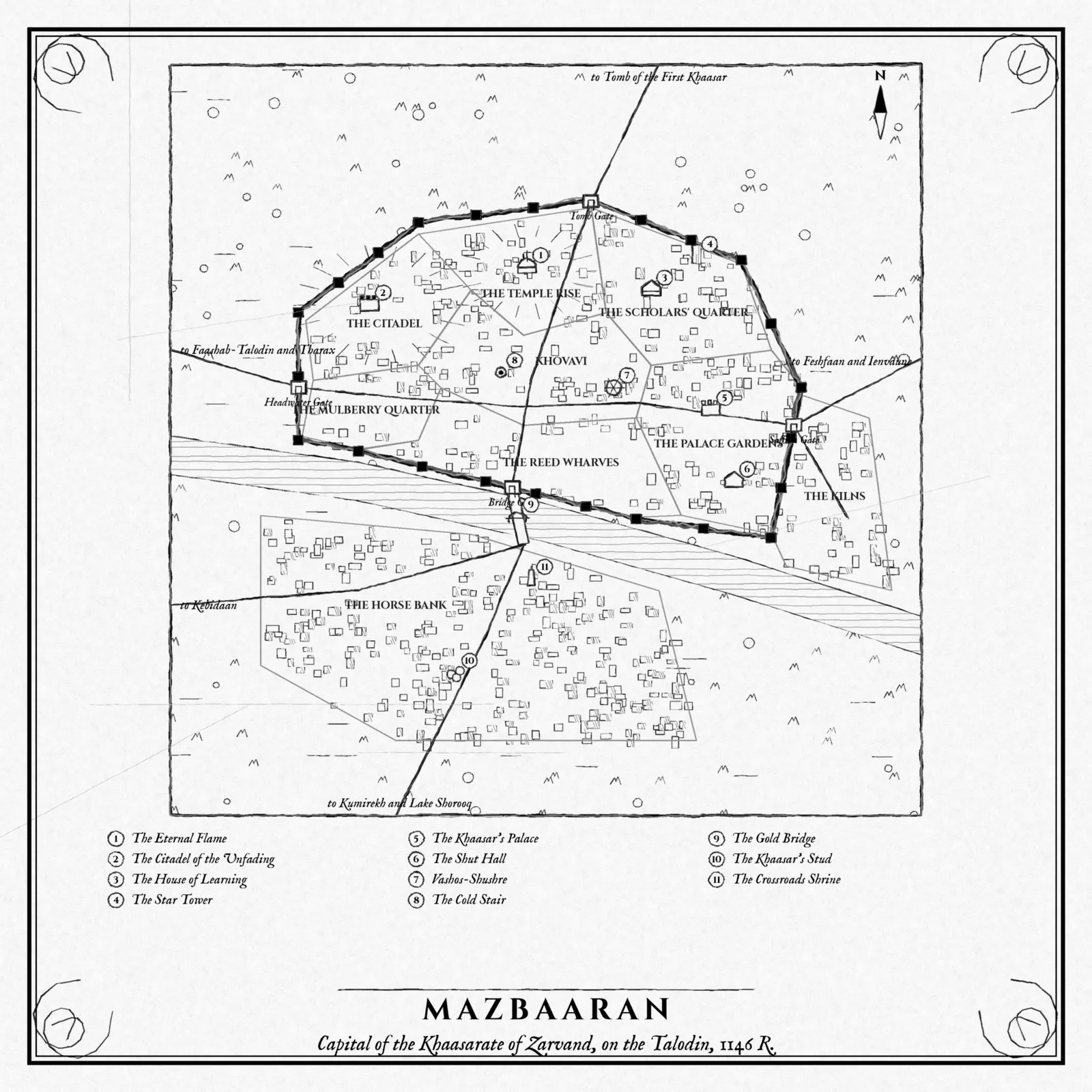
Capital of the Khaasarate of Zarvand · about 240,000 people
Come down the Talodin and you see the fire before you see the city. From half a day upstream a thin gray thread of smoke stands over the green valley, and under it, as the road bends, the domes come up out of the date palms: hundreds of blue-tiled domes, and among them the square shoulders of the wind towers, their slatted mouths turned to the north wind. The smoke rises from the largest dome, on a low rise in the middle of the city. That is the fire-temple of the Eternal Flame, and every Zarvani on the road falls silent when it comes into sight.
Camels complain at the Headwater Gate, where every caravan that arrives hands the gate-keeper its handful of salt. In the cool of the gate passage a traveler can hear water running underfoot, because a salest channel passes under the road there. The city smells of dates, dust, sandalwood smoke from the temples, dung from the caravan grounds and, in spring, the fire-roses behind every garden wall. Orange hoopoes sit on the wall tops and watch the traffic. A Mazbaarani who sees one there will tell you a letter is coming.
At a Glance
| Population | About 240,000 in the walled city and its suburbs; perhaps 60,000 more in the villages of Royal Mazbaaran |
| Ruled by | The Khaasar directly, since Royal Mazbaaran has no Jaarzeb; in truth Grand Vizier Tartal-i Kebidaan runs the city and Prince Faasheer holds its citadel |
| Walls | A ring of mud brick faced with fired brick on the north bank, with four gates tiled blue (the Headwater, Tomb, Saffron and Bridge Gates); the river guards the south side |
| Water | The River Talodin, and the salestoot that carry cooler, cleaner water under the city from intakes upstream to cisterns, wells and garden pools |
| Lives on | The Spice Way caravans, silk, paper, glass, carpets, dyes, dates, the Khaasar's horses, the licensed poppy, and learning |
| Faith | The Faith of the Eternal Flame; the Celestial Table; the Road Spirit among carriers; a hidden few Shadowed |
| Tongues | Zarvani; Maved at the caravan grounds; Caelvennois among money-changers; some Castavari in the wine and star-table trade |
| Coin | Gold talod and silver balaal; small change is the balaal cut into halves, quarters and eighths |
| Known for | The Eternal Flame, the House of Learning, Truth-day, the Khaasar's horse stud, blue domes, snake-charmers |
| Direction | CONTESTED |
History in Brief
- Before 0 R. — The Sarvani Khaasareem hold the Talodin, and their envoy signs the Accord of Surmave in 0 R. In the next century and a half they dig the valley's first great salestoot.
- 183 — Salestaad the Builder finishes the first great fire-temple around the Eternal Flame and renames the realm Zarvand. The Years of the Flame count from here.
- 330–338 — The Long Drought of the Talodin. In 336 the Jaarzebeem cast down Khaasar Hussaad II for "losing the favor of the Flame."
- 398 — The Poisoning at Mazbaaran. Khaasar Kasaadeer III, his vizier, three of his sons and forty guests die at a feast. Avisteer I burns Feshfaan.
- 681 — Khaasar Zhinraad the Learned founds the House of Learning.
- 699–701 — The First Crusade marches on Mazbaaran and dies of thirst forty miles from the Talodin.
- 840 — Talodeer the Magnificent plants Faashab-Talodin at the headwaters. In 851 he agrees to pay the Hizkari gold for naphtha.
- 1061 — Avisteer II dies of a fall from a horse; after two of his sons kill each other, Zhaasheer IV takes the throne.
- 1102 — Avisteer III becomes Khaasar at 23 and doubles the House of Learning in his first ten years.
- 1137 — The Talodin runs low. The Khaasar asks Tharax never to dam the headwaters. Tharax does not reply.
- 1139 — Talodin fire breaks the Third Crusade at Faashab-Talodin.
- 1145 — The Khaasar's health fails. Prince Faasheer takes command of the Unfading and the Citadel; Prince Durkaad is sent to Feshfaan.
- Local lore — The Shut Hall, where Kasaadeer III died, has not held a feast since 398.
- Local lore — In the Long Drought the city stood in line at the Cold Stair while the palace pools stayed full. Mazbaaranis still say "full as the palace pool" of anyone who does well in a bad year.
The Layout
Mazbaaran lies on the north bank of the Talodin where the river turns from east to southeast.
Mazbaaran lies on the north bank of the Talodin where the river turns from east to southeast. The walled city is a rough half-moon with its flat side on the water. Two rises break it: the Citadel's hill in the northwest, built on old black Builder stone, and the Temple Rise in the middle. The Long Street runs from the Headwater Gate in the west through the Great Market to the Saffron Gate in the east. A second street runs from the Tomb Gate in the north, past the temple and through the Bridge Gate to the Gold Bridge and the Horse Bank beyond, where the roads to Kebidaan and Kumirekh begin.
The Citadel. The fortress of the Unfading covers the northwestern hill: barracks, cataphract stables, a parade ground, armories and the keep. Ten thousand men live here or in the streets below, with their families, farriers, cooks and bowyers. The quarter smells of horse and hot iron, and the drill starts at dawn. The Citadel party takes its name from this hill, and the Unfading's captains like to say that its black foundation stones, older than the Khaasarate, prove the Citadel was here first.
The Temple Rise. The fire-temple of the Eternal Flame crowns the central rise, with its square before the doors and the Rahaasheem's houses, schools and storerooms packed around it. On Kelong, the fifth day of every week, the lanes up the rise are shoulder to shoulder. Rahaash Kelongaad's stray cats sleep on the warm steps, and nobody moves them.
The Scholars' Quarter. North and east of the temple lie the House of Learning, its libraries, the physicians' courts and the Star Tower, among the houses of scholars, foreign students, copyists, instrument-makers and ink-grinders. It is the quietest quarter by day and the busiest by night, when the star-watchers work. Of late, the neighbors say, the lamps in the copy rooms burn later than they used to.
The Palace Gardens. The Khaasar's palace fills the eastern end of the walled city: courts within courts, pools fed by the salestoot, mulberry and pomegranate walks, and aviaries of Talodin falcons. Courtiers, the Grand Vizier's clerks, servants and guards live in the lanes along its walls. The quarter smells of roses and wet stone.
Khovavi. The Great Market (khovavi, "market") fills the flat heart of the city along both sides of the Long Street. It is a maze of covered lanes, each trade in its own row: spice, salt, silk, glass, copper, carpets, paper, tack, saffron, pistachios. It is the loudest place in Zarvand. Money-changers weigh coins at the corners, a buyer can hear four tongues in one lane, and snake-charmers with Talodin cobras work the open corners while mothers pull their children back.
The Mulberry Quarter. West of the market, between the Citadel and the river, is the silk quarter: mulberry trees in every courtyard, silk-moth racks under awnings, reeling-houses, weavers, carpet-knotters and dyers. The gutters run red with Shorooq brine-shrimp dye and yellow with saffron. Women run most of the workshops. On hot afternoons the lanes are full of the clack of looms, and when the cocoons are boiled the smell is one visitors do not forget.
The Reed Wharves. The riverfront inside the walls is a strip of quays, boat-sheds, paper mills and carp pools. Talodin reed comes downriver in bundles and is split, soaked, pressed and dried into Zarvand's paper, on racks that stand in rows like sails. Boatmen, reed-cutters, fishermen and porters live behind the quays and eat catfish. At dawn the city washes and gossips on the water-steps called the Reed Steps.
The Kilns. Outside the walls, downstream past the Saffron Gate, lie the glass furnaces and potteries, kept out of the city for the smoke and the fear of fire. It is the poorest and hottest quarter, home to glass-blowers, potters, brick-makers, the tile-makers who glaze the blue domes, and anyone who cannot afford a courtyard. Furnace smoke stains everything gray. The city's few Shadowed live here, and people in the Kilns pinch out candles instead of blowing them.
The Horse Bank. The south shore across the Gold Bridge is watered meadow, date grove and paddock, most of it the Khaasar's stud. The rest is the caravan grounds, where trains too large for the city camp in long lines, and the villages of grooms, camel-men, date-farmers and falconers. At dusk the grooms bring the horses down to water, and half the city comes to the north bank to watch.
Landmarks
The Eternal Flame. The fire at the heart of Zarvand's faith burns in the fire-hall of the temple that Salestaad the Builder finished in 183, under the city's largest dome.
The Eternal Flame. The fire at the heart of Zarvand's faith burns in the fire-hall of the temple that Salestaad the Builder finished in 183, under the city's largest dome. The faithful say it has burned since before the Reckoning, and that Salestaad carried it from the mountains for forty days without letting it go out. Rahaash Kelongaad the Elder has tended it for fifty years, and once barred the Khaasar from the fire-hall for being drunk. Truth-day is held in the fire-hall, and the square outside is the city's place for preaching and crowds.
The Citadel of the Unfading. The keep and barracks on the northwestern hill hold the ten thousand of the Unfading, never one man short, on reused Builder black stone. Prince Faasheer has commanded it since 1145. Its gate faces the city, not the desert.
The House of Learning. Founded by Zhinraad the Learned in 681 and doubled by Avisteer III, it is the great school of Zarvand. Its star-watchers made the star tables every navigator uses and foretold the comet of 960 to the month, and its physicians sell the Khaasar's licensed poppy. Its examinations raised Tartal-i Kebidaan, the first woman to pass them, and visitors are shown the bench where she sat.
The Star Tower. The observatory of the Celestial Table is a square brick tower at the House of Learning's northern edge, with sighting-walls on its roof and a great marked arc for measuring the sun. The next year's tables are read from its steps. Prince Durkaad kept a room at the top before he was sent to Feshfaan, and it is still kept for him.
The Khaasar's Palace. Avisteer III lives here in three rooms with his books, keeps fewer guards than his father did, and has a star-watcher on the roof most nights. The walled garden at its heart, Kebid-Tarsun ("pure garden"), is the pattern every Zarvani garden copies: four water channels, a pool in the middle, fire-roses and pomegranates.
The Shut Hall. The banqueting hall where Kasaadeer III, his vizier, three sons and forty guests were poisoned in 398 stands inside the palace with its doors sealed. It is kept swept and has held no feast since. Every new Khaasar is shown it on the day he takes the throne.
Vashos-Shushre. The Great Caravanserai (vashos, "caravanserai," and shushre, "big") at the eastern end of the market is the largest on the Spice Way: two stories of rooms around a courtyard with a well, stabling for four hundred camels, and a desert bulbul in every palm. Every caravan reports here and pays the Grand Vizier's toll, and news of the whole south arrives here first.
The Cold Stair. A stepped well-house in the middle of the market goes down forty feet to an open length of the main salest channel, where the water is cold even at midsummer. It is free to all and kept by salest-diggers.
The Gold Bridge. Mazbaaran's one bridge across the Talodin is a long run of brick arches on stone piers. Its name, Jeebad-Veszush ("gold bridge"), comes from the river's color at sunset, the same color that gave the realm its name.
The Khaasar's Stud. The paddocks and stables on the Horse Bank hold the most valuable herd on the continent. Its Zarvani horses are never sold. They are given, to Jaarzebeem, foreign kings and cataphracts, and a gift from the stud is a move in the great game of the court.
The Crossroads Shrine. At the south end of the Gold Bridge, where the Kebidaan and Kumirekh roads part, stands a low stone shrine of the Road Spirit. Every caravan leaves a coin there, and in the Qaflan way nobody takes them.
The Tomb of the First Khaasar. Out of sight of the walls to the north, the tomb stands in open desert, guarded by some three hundred Tomb-Watchers who claim descent from the first Khaasar's bodyguard and have not left the place in nine centuries. A grain train leaves the Tomb Gate for them each month. Prince Faasheer has said he will stop it.
Government, Law and the Watch
Royal Mazbaaran is the Khaasar's own land, so no Jaarzeb rules the city.
Royal Mazbaaran is the Khaasar's own land, so no Jaarzeb rules the city. The Khaasar rules it directly, which in 1146 means Grand Vizier Tartal-i Kebidaan rules it. Her clerks keep the tax rolls, the salestoot, the caravan tolls, the market weights and the grain stores, and she answers to a dying man who still reads everything she sends him.
The watch is the Unfading. Its captains keep the gates, the walls and the night streets, and since 1145 they answer to Prince Faasheer. At every gate the Grand Vizier's clerks take the tolls with the Unfading's men beside them, and each side writes down what the other does.
Zarvani law rests on the oath. Contracts are sworn before a fire, a Rahaash witnesses anything large, and a Zarvani contract is the most trusted on the continent. A man proved to have broken an oath sworn on the Flame may never swear another, and that ends him in trade more surely than any fine. Poisoning is the crime every Mazbaarani fears most and speaks of least.
Trade and Work
The Spice Way ends and begins here. Caravans bring saffron from Feshfaan, wine and gold from Caelvenne's Ienvaune, pistachios from Kebidaan, red wine and silver…
The Spice Way ends and begins here. Caravans bring saffron from Feshfaan, wine and gold from Caelvenne's Ienvaune, pistachios from Kebidaan, red wine and silver from Castavar by way of Daalher, and pepper, incense, salt and dates from the south and east. The roads open in Mozaaft, the ninth month, when the cool season begins, and from then until spring the caravan grounds stretch out of sight.
The city makes silk, carpets and dyed cloth in the Mulberry Quarter, paper on the Reed Wharves, and glass and blue tile in the Kilns. The Citadel's armories forge starsteel from Dunmorrow ingots. The House of Learning sells star tables, medicine and the licensed poppy. Each trade has its guild, its row in the market and its own fire at the temple.
A day's labor earns about one balaal. Everyday prices in 1146:
| Item | Price |
|---|---|
| A day's flatbread and dates for one person | an eighth of a balaal |
| A catfish from the river | an eighth of a balaal |
| A Talodin carp from the salest pools | a quarter balaal |
| A cup of Castavari red wine | a quarter balaal |
| A licensed dose of poppy | a quarter balaal |
| Twenty sheets of Talodin-reed paper | half a balaal |
| Hire of a Mazbaaran ass for a day | half a balaal |
| A bed and supper at Vashos-Shushre | one balaal |
| An ounce of Feshfaan saffron | two talod |
| A bound copy of next year's star tables | three talod |
| A starsteel sword | fifteen talod and up |
Daily Life
The day begins before light, when the Rahaasheem feed the temple fires.
The day begins before light, when the Rahaasheem feed the temple fires. The city works through the morning, shutters itself through the hottest hours, and wakes again in the late afternoon. In summer families sleep on the roofs, and the wind towers carry cool air down into the rooms below.
Mazbaaranis eat flatbread, dates in every form, carp and catfish, mutton on feast days, pistachios, pomegranates, mulberries, and boiled grain colored with saffron when they can afford it. Wine is drunk openly: Castavari red in rich houses, date wine in poor ones. The richest houses freeze water in shallow pools on winter nights, keep the ice in straw-lined pits, and serve it with fruit in summer.
People wear long loose robes of cotton or silk, pale for every day and red or saffron for feasts. Men wear headcloths, and women of good family go veiled outside the house, as the Grand Vizier does. Scholars wear plain dark robes, and so does the Khaasar. The poor share courtyards; the rich have gardens with water in them, wind towers, and cellar rooms for summer afternoons.
Mazbaaranis take their pleasure in poetry recitals in the garden houses, where Avisteer III's verse is the measure of every poet; in storytellers in the market telling "The Rahaash and the Liar" and "The Camel Who Knew the Way"; in snake-charmers; in falconry and horse races on the Horse Bank; and in the Lantern Road's players. Children play at "the Seven Princes" in the lanes, and their mothers do not like it. Couples marry by the Fire Marriage, circling a fire seven times.
Festivals. The year begins at the spring equinox, the 1st of Nozdooz, the month of roses. The Walking of the Talodin starts at Faashab-Talodin on the 1st of Khuhor; the girl reaches Mazbaaran about ten days later, and the city lines both banks and the Gold Bridge to greet her. On the Night of the Flame, the 6th of Kelong, every fire-temple keeps watch until sunup, and the Khaasar feeds the Eternal Flame with his own hand. The next morning is Truth-day, when any subject may tell the Khaasar one true thing in the fire-hall without punishment; Avisteer III has never missed it, and once wept. On the 1st of Peenfid the next year's tables are read at the Star Tower, and for a week the Scholars' Quarter fills with foreign navigators, Castavari among them. In the Accord Days at the year's end the palace keeps the Khaasar's Day with a feast, held in any hall but the Shut Hall.
Faith
Mazbaaran is the holy city of the Faith of the Eternal Flame, which teaches that the world is a struggle between Light, which is truth, order and fire, and Shad…
Mazbaaran is the holy city of the Faith of the Eternal Flame, which teaches that the world is a struggle between Light, which is truth, order and fire, and Shadow, which is lies and chaos. Every quarter has its fire-temple and every temple its school, and the schools teach every child the letters and the numbers, in that order. Pomegranate seeds are blessed at the temples, and the hoopoes are sacred to the Flame. Mazbaaranis say never to speak a lie within sight of a fire-temple dome, which here is nearly everywhere.
The Celestial Table is at home in the House of Learning, and the Flame counts it a harmless branch of itself. The Road Spirit has its shrine at the Gold Bridge and a following among the camel-men. The few Shadowed keep their two fires behind closed doors in the Kilns. Avisteer III has refused to hunt them, and Prince Faasheer has promised the Rahaasheem he will burn their temples when he is crowned. The Ember Pilgrims are exiled from Zarvand, and Brother Ash, once a Rahaash here, is remembered by people who do not say his name aloud. The Rahaasheem themselves are split between the Citadel and the old Khaasar, and all of them watch Rahaash Kelongaad, because whichever prince he crowns will be Khaasar.
Crime and the Underside
A city built on honesty has a large trade in the other thing.
A city built on honesty has a large trade in the other thing. Unlicensed poppy comes up the Kumirekh road under bales of dates and is sold in the Kilns and behind the Reed Wharves. Deep Sands salt moves outside the tolls. Forged star tables, with errors that wreck ships, are sold to foreigners in the week of the Reading.
The most valuable thing smuggled here is news. Mozaaft of the Deep Sands sells it along with salt and poppy, and Zesose the Wheel's rogue caravan carries letters for whoever pays. Every prince has men in the city, and the money-changers know which ones. The Unfading do not walk the Kilns at night.
People of Note
- Khaasar Avisteer III (67) — poet, star-watcher and dying Khaasar; has perhaps a year.
- Prince Faasheer (41) — eldest son and commander of the Unfading; holds the Citadel.
- Prince Durkaad (33) — the favorite, governor of Feshfaan since 1145; his room in the Star Tower is kept for him.
- Grand Vizier Tartal-i Kebidaan (54) — runs the treasury, the salestoot, the tolls and the city.
- Rahaash Kelongaad the Elder (78) — keeper of the Eternal Flame for fifty years; feeds the temple cats and will not lie.
- Mozaaft of the Deep Sands (36) — caravan-master and smuggler, at Vashos-Shushre when he is in the city.
- Brother Ash (45) — once a Rahaash here, now the exiled voice of the One Light.
- Shozzaz the Salest-Digger — keeper of the Cold Stair, sixty, who knows the channels by touch and says the water has fallen three summers running.
- Qifeekh the Snake-Charmer — the best-known cobra-handler in Khovavi, who hears everything said at her corner and sells some of it.
- Zarrit the Money-Changer — a Kebidaan-born changer at the Saffron Gate, trusted by the Qaflan.
- Hasal the Silent — the silent Twinkeeper of the Kilns' hidden two-fire temple, whose speaking partner died in the spring.
- Veelbat the Dyer — head of the largest dye-house in the Mulberry Quarter, who dyes the robes of Durkaad's household.
Rumors and Story Hooks
- The Khaasar is writing a last poem to be read to all seven sons at once, and only the Grand Vizier is allowed in the room.
- Faasheer's men have asked Rahaash Kelongaad to declare in the fire-hall that the Flame favors the eldest. The old man has been seen walking the temple square at night.
- The copy rooms work all night, and Qaflan are buying paper by the bale.
- A captain of the Unfading who served the old Khaasar twenty years has been told to be ready to ride to Feshfaan.
- Shozzaz swears the water at the bottom of the Cold Stair is a hand lower every summer. If the snows fail again, the Grand Vizier must choose between the palace pools and the city.
- Brother Ash has been seen on the Kumirekh road, walking toward the city that exiled him.
- The Unfading have asked Veelbat for her list of customers, and Durkaad's friends are wondering who else has been asked.
- A Kilns tile-maker rebuilding a furnace broke into a vaulted room of black stone under his floor. He has told only Hasal the Silent, who tells no one anything.
- Zarrit has changed more Castavari silver this year than in the last five, for men who are not merchants. He does not know whether it pays for spies, for the Hizkari, or for a prince.
- The Shut Hall's doors were found unsealed one morning last Tiqeez and sealed again by noon. The palace says it was the sweepers.
Where It Is Going
Mazbaaran is CONTESTED. It is the richest and most learned city in the south, and in 1146 it belongs to three people at once: a dying Khaasar in the palace, a G…
Mazbaaran is CONTESTED. It is the richest and most learned city in the south, and in 1146 it belongs to three people at once: a dying Khaasar in the palace, a Grand Vizier who runs its water and money, and a prince who holds its citadel with ten thousand men. When Avisteer III dies the city will be Faasheer's by force on the first night, unless Rahaash Kelongaad crowns someone else, and then it will be fought over in its own streets. Meanwhile the House of Learning is sending its learning out by the bale, the river is falling, and Castavar is making ready a Fourth Crusade. Nobody in Mazbaaran doubts that the Flame will go on burning. What they doubt is whose hand will feed it on the next Night of the Flame.